
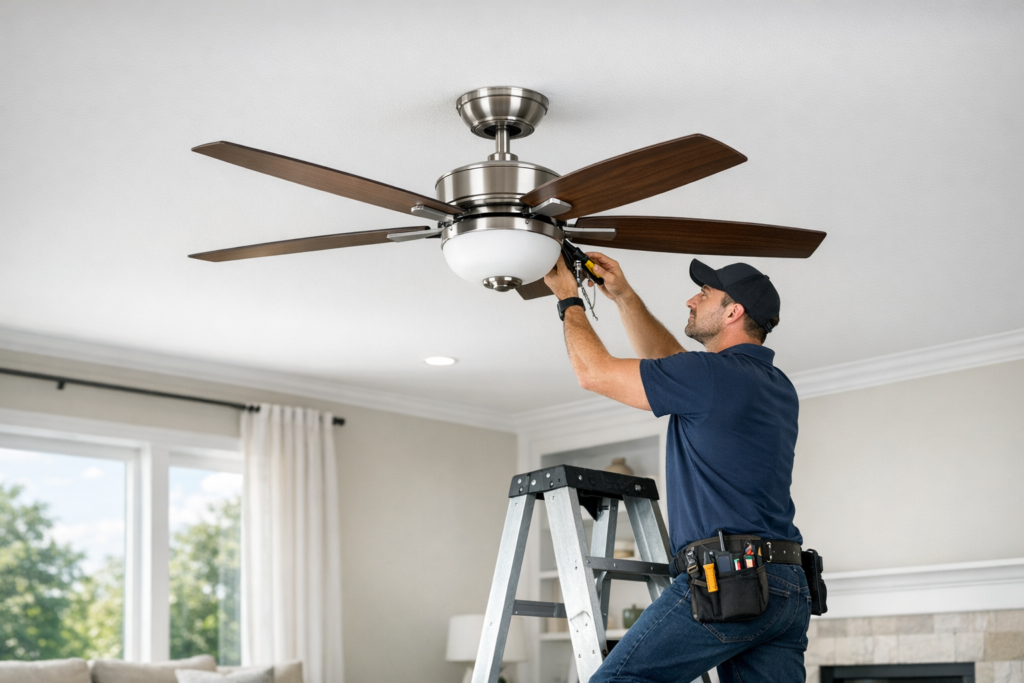
Ceiling fan installation does more than make a room feel cooler. When the fan is properly selected, wired, mounted, and balanced, it can improve year-round comfort, support energy efficiency, enhance lighting, reduce strain on heating and cooling systems, and make everyday spaces more functional. For homeowners, property managers, and businesses throughout New Hampshire, Massachusetts, Maine, and Vermont, a professionally installed ceiling fan is often a practical upgrade with benefits that extend well beyond air movement.
Why Ceiling Fans Are More Useful Than Many People Realize
A ceiling fan does not lower the actual temperature of a room the way an air conditioner does. Instead, it moves air across the skin, helping people feel cooler in warm weather. In colder months, many ceiling fans can be reversed to gently circulate warm air that collects near the ceiling.
That simple function can make a noticeable difference in comfort, especially in rooms with high ceilings, uneven temperatures, limited airflow, or large windows. In New England homes and commercial buildings, where seasonal temperature swings are significant, improved air circulation can help rooms feel more consistent throughout the year.
Professional ceiling fan installation also ensures the fan is safely supported, correctly wired, properly controlled, and matched to the room. Those details matter because a ceiling fan is a moving electrical fixture, not just a decorative accessory.
Key Benefits Of Professional Ceiling Fan Installation
A well-planned ceiling fan installation can improve comfort and convenience in several ways. The biggest benefits typically include better airflow, improved energy performance, added lighting, quieter operation, and greater long-term reliability.
Improved Air Circulation
Ceiling fans help move stagnant air, which is especially valuable in bedrooms, living rooms, offices, retail spaces, conference rooms, and finished basements. Better air movement can make a space feel fresher and more comfortable without relying solely on air conditioning.
Air circulation is also helpful in rooms with uneven temperatures. Open floor plans, vaulted ceilings, sunrooms, and upper-floor bedrooms often experience hot or cool spots. A properly placed ceiling fan can help distribute air more evenly.
Better Comfort In Warm Weather
During summer, a ceiling fan can create a cooling effect that allows occupants to feel more comfortable without immediately lowering the thermostat. This can be especially useful during humid New England summers, when rooms may feel stuffy even before the temperature becomes extreme.
The fan should rotate in the direction recommended by the manufacturer for warm-weather use, typically pushing air downward to create a breeze. Correct speed settings also matter. A fan that is too small or installed too high may not move enough air to provide meaningful comfort.
Help With Winter Air Distribution
Many ceiling fans include a reverse setting for colder months. When used at a low speed, the fan can help circulate warm air that naturally rises toward the ceiling. This is particularly helpful in rooms with tall ceilings, loft areas, open stairways, and large common areas.
The goal in winter is not to create a noticeable breeze. It is to gently move warm air back into the occupied space. Correct fan direction and speed are important for comfort.
Reduced Strain On Heating And Cooling Systems
Ceiling fans can support HVAC performance by improving how air moves through a room. While they are not a replacement for heating or air conditioning, they can help occupants feel comfortable at more moderate thermostat settings in some conditions.
For homeowners and business owners focused on energy efficiency, this makes ceiling fan installation a practical part of a broader comfort strategy. The best results come from pairing ceiling fans with proper insulation, efficient HVAC equipment, sealed drafts, and thoughtful thermostat use.
Integrated Lighting Options
Many modern ceiling fans include integrated LED lighting or light kit compatibility. This can improve both airflow and room illumination with one fixture. In bedrooms, kitchens, offices, and rental properties, a fan with lighting can replace an outdated fixture while adding new functionality.
Lighting quality should not be an afterthought. Consider brightness, color temperature, dimming compatibility, and how the fixture fits the purpose of the room. A licensed electrician can help determine whether existing wiring and controls support the desired fan and lighting configuration.
Why Proper Installation Matters For Safety
Ceiling fan installation should be handled carefully because fans are heavier than many light fixtures and create vibration while operating. A standard electrical box that was designed only for a light fixture may not be approved to support a ceiling fan.
A ceiling fan must be mounted to a fan-rated electrical box or an appropriate structural support system. This is one of the most important safety considerations. If the fan is attached to an inadequate box, it may wobble, loosen, damage the ceiling, or become a hazard.
Professional installation also helps ensure that wiring connections are correct, switches and controls operate properly, grounding is addressed, and the installation follows applicable electrical standards. This is especially important in older homes found throughout New Hampshire, Massachusetts, Maine, and Vermont, where existing wiring may have been modified many times over the years.
Common Problems With DIY Ceiling Fan Installation
Ceiling fan installation may look straightforward, but several problems can occur when the existing electrical setup is not evaluated correctly. Common issues include:
- Using a non-fan-rated ceiling box
- Mounting the fan to weak or unsupported framing
- Incorrect wire connections
- Improper switch leg or control wiring
- Fan wobble caused by poor mounting or blade imbalance
- Incompatible dimmers, wall controls, or remote controls
- Insufficient ceiling clearance
- Incorrect fan size for the room
Some of these issues create inconvenience. Others can create genuine safety concerns. If there is any uncertainty about the wiring, box rating, ceiling structure, or control setup, the safest approach is to call a qualified electrician.
Choosing The Right Ceiling Fan For The Room
The best ceiling fan is not always the largest or most decorative option. Fan size, mounting height, blade span, motor quality, controls, and moisture rating all affect performance.
Room Size And Blade Span
A fan that is too small may not circulate enough air. A fan that is too large can overpower the room visually and create uncomfortable airflow. Bedrooms, living rooms, offices, open common areas, and commercial spaces may each require different fan sizes.
Large rooms may need a wider fan or multiple fans to move air effectively. Long or irregularly shaped spaces often benefit from more than one fixture rather than one oversized fan placed in the center.
Ceiling Height And Mounting Style
Ceiling height determines whether a flush-mount, standard downrod, or extended downrod installation is appropriate. Low ceilings may require a hugger-style fan to maintain safe clearance. High or vaulted ceilings often require a downrod to position the fan where it can move air effectively.
Mounting height is not only about appearance. If the fan is mounted too close to the ceiling, it may not circulate air well. If it is hung too low, it may interfere with safe use of the room.
Indoor, Damp-Rated, And Wet-Rated Fans
Not every ceiling fan is designed for every environment. Indoor fans are intended for dry interior spaces. Damp-rated fans are typically used in covered areas where moisture may be present but direct water exposure is not expected. Wet-rated fans are designed for more exposed conditions.
This distinction is important for porches, covered patios, garages, workshops, and certain commercial settings. New England weather brings moisture, temperature changes, and seasonal humidity, so choosing the correct rating helps protect the fan and the electrical system.
Controls And Smart Features
Ceiling fans may be controlled by pull chains, wall switches, remote controls, smart controls, or integrated lighting controls. The best option depends on the wiring available, the room layout, accessibility needs, and personal preference.
Smart fans and advanced controls can be convenient, but compatibility matters. Existing wiring may not support every control type without modification. An electrician can evaluate whether new wiring, a control box, or a different switch arrangement is needed.
Ceiling Fans In Older New England Homes
Many homes throughout New Hampshire, Massachusetts, Maine, and Vermont were built before today’s electrical demands were common. Older homes may have outdated wiring, undersized boxes, plaster ceilings, limited switch wiring, or prior repairs that are not obvious from the room below.
Before installing a ceiling fan in an older home, an electrician may need to verify whether the existing ceiling box is fan-rated, whether wiring is in good condition, whether grounding is present, and whether the circuit can safely support the new fixture. These checks are especially important when replacing an older light fixture with a fan.
Historic and older properties can often be upgraded successfully, but they require extra care. Protecting the building while improving safety and function is part of a professional installation approach.
Commercial Ceiling Fan Installation Considerations
Ceiling fans are not limited to homes. Commercial properties can benefit from improved air movement in offices, reception areas, retail spaces, restaurants, fitness areas, warehouses, workshops, and multi-use facilities.
Commercial ceiling fan installation often involves additional planning. Ceiling height, occupancy patterns, equipment heat, lighting layout, building controls, electrical capacity, and maintenance access all matter. In larger spaces, high-volume fans or multiple coordinated fans may be considered depending on the application.
For property managers and facility managers, reliable installation is especially important because a poorly selected or improperly mounted fan can create maintenance issues, noise complaints, and safety concerns.
What To Expect During A Professional Installation
A professional electrician starts by evaluating the existing electrical box, wiring, circuit conditions, ceiling structure, and control options. If the current box is not suitable for a fan, it must be replaced or supported correctly before the fan is installed.
A typical ceiling fan installation may include:
- Confirming the existing electrical setup is appropriate
- Installing or verifying a fan-rated support box
- Assembling the fan according to manufacturer instructions
- Making safe electrical connections
- Installing wall controls, remote receivers, or light kits when applicable
- Testing fan speeds, direction, lighting, and controls
- Checking for wobble, vibration, or unusual noise
If new wiring is needed, the project may take longer. This can happen when adding a fan where no ceiling fixture exists, separating fan and light controls, adding a wall switch, or upgrading outdated wiring.
Cost Factors That Affect Ceiling Fan Installation
The cost of ceiling fan installation depends on the condition of the existing electrical system and the complexity of the project. Replacing a properly supported existing fan is usually more straightforward than adding a fan to a ceiling with no fixture or inadequate wiring.
Common factors that influence cost include:
- Whether a fan-rated box is already installed
- Whether new wiring or a new switch is required
- Ceiling height and access conditions
- Fan size and weight
- Remote control, smart control, or dimming requirements
- Whether lighting is included
- Condition of existing wiring in older homes
- Number of fans being installed
The most accurate way to understand cost is to have the installation conditions evaluated. A low-cost installation that ignores structural support or wiring concerns can become expensive if it leads to damage or unsafe operation.
When To Replace An Existing Ceiling Fan
Replacement may be worthwhile when an existing fan is noisy, unstable, outdated, inefficient, or no longer matches the needs of the room. Warning signs that a fan should be inspected or replaced include:
- Persistent wobbling even after balancing
- Grinding, humming, or clicking noises
- Flickering lights or unreliable controls
- Visible damage to blades, housing, or mounting hardware
- Overheating odors or signs of electrical issues
- Poor airflow compared with the room size
- An outdated fixture mounted to an unknown ceiling box
If a ceiling fan shows signs of electrical trouble, stop using it and have it inspected by a licensed electrician. Intermittent operation, burning smells, or heat at the switch or fan housing should never be ignored.
Maintenance Tips For Long-Term Performance
Ceiling fans require simple maintenance to stay quiet, balanced, and efficient. Dust buildup on blades can affect balance and airflow. Loose screws or changing blade alignment can create wobble over time.
Helpful maintenance steps include:
- Dusting blades regularly
- Checking for loose blade screws
- Using the correct fan direction for the season
- Replacing bulbs with compatible options
- Avoiding incompatible dimmer switches
- Scheduling an electrical inspection if noise, wobble, or flickering develops
For rental properties, offices, and commercial spaces, ceiling fans should be included in routine maintenance checks. Small issues are easier to correct before they become safety concerns or tenant complaints.
Is A Ceiling Fan Right For Every Room?
A ceiling fan is a good choice for many rooms, but not every space is ideal. The room must have adequate ceiling height, proper support, appropriate wiring, and enough clearance from walls, doors, cabinets, bunk beds, equipment, and other obstructions.
Rooms with low ceilings, unusual ceiling structures, or limited electrical access may require special planning. In some cases, improved lighting, ventilation, or HVAC adjustments may be a better solution. A qualified electrician can help determine whether ceiling fan installation is practical and safe for the space.
Work With A Licensed Electrician For A Safer, Better Result
Ceiling fan installation is one of those upgrades that looks simple but depends heavily on what is hidden above the ceiling. Proper support, safe wiring, correct controls, and careful setup all affect how well the fan performs over time.
Electrical Constructors LLC provides residential and commercial electrical services throughout New Hampshire, Massachusetts, Maine, and Vermont, including ceiling fan installation, lighting upgrades, electrical troubleshooting, panel work, inspections, and system improvements. Whether you are upgrading one room, improving a rental property, or planning electrical work for a larger commercial space, working with an experienced electrical contractor helps ensure the installation is safe, functional, and built for long-term reliability.