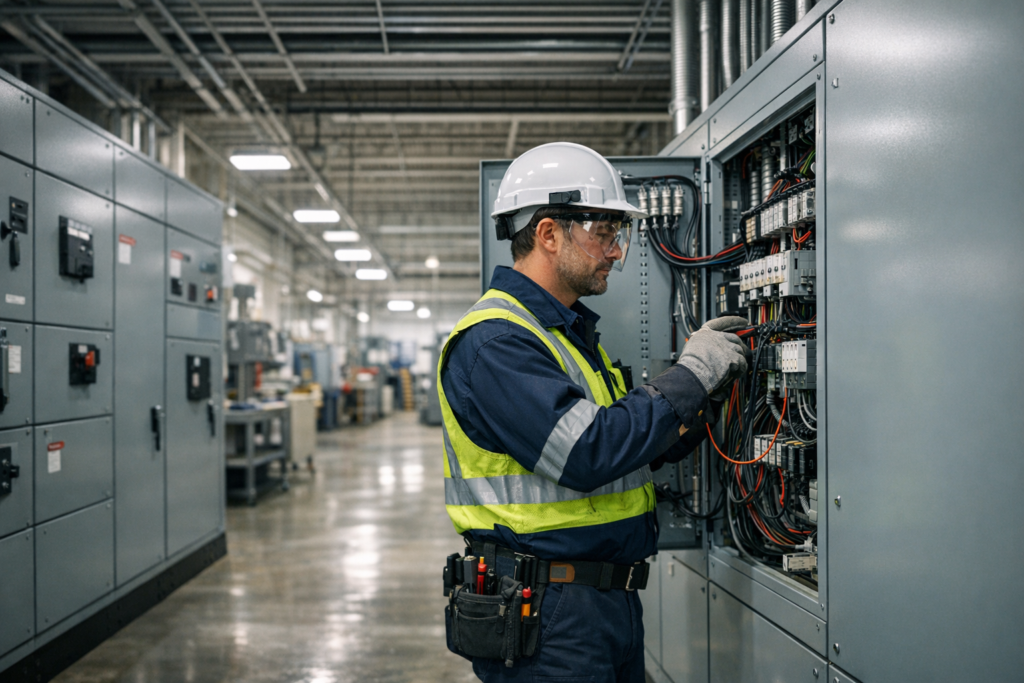
Reliable production depends on reliable power. A strong industrial electrical maintenance program helps manufacturing facilities reduce unplanned downtime, protect employees, extend equipment life, and identify electrical problems before they interrupt operations. For plant managers, maintenance teams, property owners, and facility managers, the goal is not simply to fix electrical failures after they happen. The goal is to build a safer, more predictable electrical system that supports daily production and long-term growth.
Why Industrial Electrical Maintenance Matters in Manufacturing
Manufacturing facilities place constant demand on electrical systems. Motors, drives, conveyors, compressors, production lines, lighting, control panels, HVAC equipment, and process machinery often run for long hours under demanding conditions. Over time, electrical components are exposed to heat, vibration, dust, moisture, mechanical wear, and changing production loads.
Without routine industrial electrical maintenance, small issues can become expensive failures. A loose connection can create heat. A deteriorating breaker can fail to trip properly. A worn motor starter can cause intermittent production interruptions. A poorly labeled panel can slow emergency response. These may seem like minor conditions until they affect employee safety, equipment performance, or production schedules.
A well-maintained industrial electrical system supports:
- Improved uptime and production reliability
- Reduced risk of electrical fires and equipment damage
- Safer working conditions for employees and maintenance personnel
- Longer service life for electrical equipment
- Better troubleshooting when problems occur
- Improved energy efficiency and power quality
- More accurate planning for upgrades and capital improvements
For manufacturers throughout New Hampshire, Massachusetts, Maine, and Vermont, maintenance is especially important in facilities with aging infrastructure, seasonal load changes, winter weather concerns, or older electrical distribution equipment that may no longer match current production demands.
Start With a Documented Preventive Maintenance Plan
The most effective electrical maintenance programs are planned, documented, and repeatable. Relying on memory, informal notes, or reactive service calls leaves too much room for missed equipment, inconsistent inspections, and delayed repairs.
A preventive maintenance plan should identify the critical electrical assets in the facility, establish inspection intervals, define who is responsible for each task, and create a clear system for tracking deficiencies and corrective action. The plan should be practical enough for day-to-day use but detailed enough to support safety, compliance, and long-term electrical reliability.
Key items to document include:
- Main electrical service equipment and switchgear
- Electrical panels, transformers, disconnects, and distribution equipment
- Motor control centers, starters, drives, and production controls
- Emergency systems, backup power, and generator equipment
- Lighting systems, exit lighting, and emergency lighting
- Surge protection and power quality equipment
- Grounding and bonding systems
- Known electrical deficiencies and repair history
- Equipment age, load changes, and planned production expansions
Good documentation also helps electricians troubleshoot faster. When panel schedules, equipment labels, one-line diagrams, and maintenance records are accurate, problems can be isolated more efficiently and with less disruption to production.
Inspect Electrical Panels, Switchgear, and Distribution Equipment
Electrical distribution equipment is the backbone of a manufacturing facility. If panels, switchgear, transformers, or disconnects are neglected, equipment failures can affect large portions of the operation.
Routine inspections should look for visible damage, heat discoloration, unusual odors, corrosion, missing covers, blocked access, improper labeling, overloaded equipment, worn components, and signs of moisture intrusion. Electrical rooms should remain clean, dry, and accessible. Storage should not block panels or switchgear, and equipment should never be treated as shelving or work surfaces.
Common warning signs include:
- Breakers that trip repeatedly
- Buzzing, crackling, or humming from electrical equipment
- Warm or discolored panel covers
- Burning odors near electrical gear
- Rust, condensation, or water stains
- Missing knockouts, covers, or dead fronts
- Outdated or unreadable circuit directories
- Temporary wiring that has become permanent
Electrical panels and switchgear should only be opened, tested, or serviced by qualified electrical professionals. Industrial electrical equipment can contain high fault current and serious arc flash hazards. Visual observations by facility staff can be useful, but hands-on diagnostics and repairs require proper training, tools, and safety procedures.
Use Thermal Imaging to Find Hidden Electrical Problems
Thermal imaging is one of the most valuable tools in industrial electrical maintenance because it can help identify abnormal heat before failure occurs. Many electrical problems generate heat long before a breaker trips or equipment stops working.
Thermographic inspections may help detect:
- Loose or deteriorated connections
- Overloaded circuits or phases
- Failing breakers or contactors
- Imbalanced loads
- Transformer hot spots
- Motor control center issues
- Abnormal heating in disconnects and starters
Thermal imaging is most useful when equipment is operating under normal load. This allows the electrician to compare temperatures across similar conductors, phases, and components. A single hot spot does not always identify the full cause, but it provides valuable direction for further testing and repair.
For manufacturing facilities that run multiple shifts or depend on continuous production, thermal scanning can help prioritize maintenance during planned shutdowns instead of discovering problems during an unexpected outage.
Maintain Motors, Drives, Starters, and Control Equipment
Motors and control equipment are often among the most important electrical assets in a manufacturing facility. When a critical motor, variable frequency drive, contactor, relay, sensor, or motor starter fails, production can stop immediately.
Electrical maintenance for motor-related systems should include inspection of wiring, terminations, overload protection, disconnects, control circuits, enclosures, cooling fans, ventilation paths, and environmental conditions. Dust buildup, poor airflow, excessive heat, vibration, and moisture can shorten the life of electrical components.
Variable frequency drives require special attention because they are sensitive to heat, contaminants, grounding issues, harmonics, and power quality concerns. Keeping drives clean, properly ventilated, and correctly protected helps improve reliability.
Facilities should also pay attention to repeated equipment faults. If a motor overload trips frequently, resetting it without identifying the cause can hide a larger problem. The underlying issue may involve mechanical binding, improper loading, voltage imbalance, deteriorated wiring, failing bearings, poor ventilation, or incorrect protection settings. A qualified electrician can help determine whether the problem is electrical, mechanical, or both.
Prioritize Power Quality and Load Management
Power quality problems can be difficult to identify because they do not always cause immediate equipment failure. Instead, they may show up as nuisance trips, premature equipment wear, flickering lights, control errors, overheated transformers, or intermittent production problems.
Manufacturing facilities with large motors, welders, compressors, drives, robotics, sensitive electronics, or automated controls should evaluate whether their electrical system is supporting stable performance. Load growth over time can also create issues. A facility may have been properly designed years ago, but production changes, added equipment, and expanded shifts can push the system beyond its original intent.
Electrical load management may involve:
- Reviewing service capacity and distribution loads
- Balancing loads across phases
- Evaluating transformer loading
- Investigating harmonics and voltage fluctuations
- Correcting undersized or aging equipment
- Planning service upgrades or dedicated circuits for new machinery
- Coordinating production equipment startup sequences
Power quality evaluations are especially important before adding major equipment. Installing new production machinery without reviewing available electrical capacity can result in performance problems, code corrections, or costly rework.
Keep Electrical Rooms Clean, Accessible, and Organized
Housekeeping is an often overlooked part of industrial electrical maintenance. Electrical rooms should be treated as controlled spaces, not storage areas. Clear access helps electricians work safely, reduces fire risk, and allows faster response during outages or emergencies.
Best practices include keeping electrical equipment free from dust accumulation, maintaining clear working space, protecting equipment from water exposure, ensuring adequate ventilation, and keeping labels visible. Conduit, panels, disconnects, and junction boxes should not be used to hang tools, materials, or temporary equipment.
Manufacturing environments often contain dust, fibers, metal particles, moisture, oils, chemicals, or temperature extremes. These conditions can affect electrical equipment if enclosures are damaged, improperly selected, or not maintained. Facilities should ensure electrical equipment is appropriate for the environment where it is installed.
Improve Labeling, Panel Schedules, and Electrical Documentation
Accurate labeling is a practical safety and productivity issue. When circuits are poorly labeled, troubleshooting takes longer, lockout procedures become more difficult, and the wrong equipment may be shut down during maintenance.
Manufacturing facilities should maintain clear identification for panels, disconnects, motor controls, emergency shutoffs, transformers, junction boxes, and major equipment feeds. Panel schedules should be updated whenever circuits are added, moved, or repurposed.
Good electrical documentation can include:
- Updated panel schedules
- Equipment identification labels
- One-line electrical diagrams
- Maintenance records and inspection reports
- Repair notes and deficiency lists
- Generator and emergency power documentation
- Records of electrical upgrades and equipment additions
This information becomes especially valuable during emergencies, production expansions, property transactions, insurance reviews, and capital planning.
Schedule Maintenance Around Production Needs
Electrical maintenance should be coordinated with production schedules whenever possible. Planned downtime is almost always less disruptive than emergency downtime. A qualified electrical contractor can help prioritize work so the most important repairs happen during shutdowns, off-hours, weekends, or seasonal slow periods.
Not every maintenance task requires a full shutdown. Some visual inspections, documentation updates, thermal scans, exterior equipment checks, and planning work can often be performed while the facility remains operational. Other tasks, such as tightening terminations, replacing breakers, servicing switchgear, modifying feeders, or testing certain equipment, may require de-energizing equipment and following proper safety procedures.
An effective plan separates work into categories:
- Immediate safety concerns that need prompt correction
- High-priority reliability issues that threaten production
- Preventive repairs that can wait until scheduled downtime
- Long-term upgrades that should be included in capital planning
- Documentation and labeling work that improves future maintenance
This approach helps facility leaders make informed decisions instead of reacting to every issue as an emergency.
Plan for Aging Electrical Infrastructure
Many manufacturing buildings in New England have gone through decades of equipment changes, additions, renovations, and production shifts. Even when the electrical system was properly installed originally, age and changing usage can create reliability concerns.
Older electrical infrastructure may include obsolete panels, limited spare capacity, deteriorated insulation, outdated control equipment, worn disconnects, undersized feeders, or undocumented modifications. These conditions do not always require immediate replacement, but they should be evaluated and planned for before they become production risks.
Warning signs that a facility may need electrical upgrades include:
- Frequent nuisance tripping or recurring electrical faults
- Lack of capacity for new equipment
- Overcrowded panels or limited spare circuits
- Obsolete parts that are difficult to source
- Repeated temporary wiring solutions
- Production expansion without electrical infrastructure review
- Visible deterioration of electrical equipment
Proactive planning allows facility owners and managers to budget for orderly upgrades instead of being forced into emergency replacements after a failure.
Do Not Overlook Lighting, Emergency Systems, and Backup Power
Industrial electrical maintenance is not limited to production machinery and panels. Lighting, emergency systems, and backup power also play an important role in safety and continuity.
Manufacturing facilities should regularly evaluate interior and exterior lighting levels, especially in production areas, loading docks, parking areas, mechanical spaces, storage zones, and emergency egress paths. Poor lighting increases the risk of accidents and makes maintenance work more difficult.
Emergency lighting and exit signs should be inspected and tested periodically so they operate when needed. Backup generators, transfer switches, and related emergency power systems should also be maintained according to manufacturer recommendations and facility needs. In New Hampshire, Massachusetts, Maine, and Vermont, winter storms, ice, high winds, and utility outages can make generator preparedness especially important for facilities that cannot afford extended downtime.
Backup power planning should consider which loads are truly critical. Production equipment, life safety systems, IT infrastructure, refrigeration, process controls, security, and environmental systems may all have different power requirements. A thoughtful design prevents overloading the generator and helps keep essential operations running during an outage.
Address Surge Protection and Equipment Protection
Modern manufacturing facilities often rely on sensitive electronic controls, automation systems, drives, sensors, computers, and communication equipment. These assets can be vulnerable to voltage spikes and electrical disturbances.
Surge protection can help reduce the risk of damage from certain transient voltage events. It should be considered as part of a broader electrical protection strategy that may also include proper grounding and bonding, equipment maintenance, power quality analysis, and good distribution design.
No protective device can prevent every possible electrical event, but a layered approach can reduce risk and improve resilience. Facilities that have experienced unexplained control failures, damaged electronics, or repeated power-related equipment issues should have the electrical system evaluated by a qualified contractor.
Train Staff to Recognize Electrical Warning Signs
Production employees and maintenance staff are often the first to notice abnormal electrical conditions. They do not need to perform electrical work to play an important role in safety. They should know what to report and when to stop using equipment.
Employees should report:
- Burning smells or smoke near electrical equipment
- Sparks, arcing, or popping sounds
- Repeated breaker trips or blown fuses
- Damaged cords, plugs, or receptacles
- Equipment that shocks, tingles, or behaves inconsistently
- Water near electrical equipment
- Hot disconnects, panels, or control enclosures
- Missing covers or exposed wiring
Any suspected electrical hazard should be taken seriously. Employees should not reset equipment repeatedly, open energized panels, bypass safety devices, or attempt electrical repairs unless they are qualified and authorized to do so.
Common Electrical Maintenance Mistakes to Avoid
Many electrical failures are preventable. Avoiding common maintenance mistakes can reduce downtime and improve safety throughout the facility.
- Waiting for failure before calling an electrician: Reactive maintenance often costs more than planned service and can interrupt production at the worst possible time.
- Ignoring nuisance trips: A breaker or overload device that trips repeatedly is signaling a problem that should be diagnosed.
- Using temporary wiring as a permanent solution: Temporary fixes can create safety hazards and should not replace properly designed installations.
- Adding equipment without reviewing capacity: New machinery can overload panels, transformers, feeders, or service equipment if the system is not evaluated first.
- Neglecting documentation: Poor labeling and outdated panel schedules slow troubleshooting and increase operational risk.
- Overlooking environmental conditions: Dust, moisture, chemicals, heat, and vibration can shorten equipment life if enclosures and maintenance practices are not appropriate.
- Skipping planned shutdown work: Deferred maintenance can accumulate until multiple problems appear at once.
How Often Should a Manufacturing Facility Schedule Electrical Maintenance?
The right maintenance frequency depends on the facility size, equipment type, operating hours, environment, age of the electrical system, criticality of production, and history of electrical issues. A lightly used facility with newer equipment may not require the same schedule as a high-demand plant operating multiple shifts in a dusty or harsh environment.
As a practical starting point, many facilities benefit from a combination of routine visual checks by trained staff, periodic professional inspections, thermal imaging at planned intervals, and more detailed maintenance during scheduled shutdowns. Critical equipment should receive closer attention, especially if failure would stop production, create safety hazards, or cause significant financial loss.
A licensed electrical contractor can help develop a maintenance schedule based on actual site conditions rather than a generic checklist. This approach is more useful because it reflects how the facility operates, what equipment is most important, and where risks are most likely to develop.
When to Call a Licensed Industrial Electrical Contractor
Facility staff may handle basic observation, documentation, and reporting, but industrial electrical work should be performed by qualified professionals. Manufacturing electrical systems are complex, and improper repairs can create serious safety and reliability problems.
Call a licensed electrical contractor when you need:
- Electrical troubleshooting for recurring equipment issues
- Panel, switchgear, or distribution equipment inspection
- Thermal imaging and follow-up repairs
- Service upgrades or capacity evaluations
- New equipment power installation
- Motor control, drive, or disconnect work
- Generator installation or backup power planning
- Lighting upgrades or emergency lighting service
- Code corrections or electrical safety improvements
- Preventive electrical maintenance planning
Electrical Constructors LLC provides residential, commercial, industrial, and new construction electrical services throughout New Hampshire, Massachusetts, Maine, and Vermont. For manufacturing facilities, the right electrical partner can help reduce downtime, improve safety, and identify practical solutions before problems become costly emergencies.
Building a Safer, More Reliable Facility
Industrial electrical maintenance is an investment in uptime, safety, and predictable operations. The best programs combine regular inspections, accurate documentation, thermal imaging, power quality awareness, equipment-specific maintenance, staff training, and timely repairs by qualified electricians.
Manufacturing facilities depend on electrical systems that are often working hard behind the scenes every hour of the day. When those systems are maintained properly, production runs more smoothly, employees work more safely, and facility leaders gain better control over future electrical needs. Whether your facility is addressing aging infrastructure, planning equipment upgrades, improving backup power, or building a preventive maintenance program, a proactive approach is the most reliable path forward.