The most effective commercial electrical upgrades improve energy efficiency by reducing wasted power, modernizing outdated systems, and giving building owners better control over lighting, equipment, heating, cooling support loads, and electrical demand. For businesses, property managers, developers, and facility teams, the right upgrades can lower operating costs while improving safety, reliability, and long-term building performance.
In New Hampshire, Massachusetts, Maine, and Vermont, many commercial properties operate in buildings with aging infrastructure, seasonal energy swings, and increasing electrical demands from HVAC systems, computers, refrigeration, tenant equipment, security systems, EV charging, and backup power. A well-planned electrical upgrade strategy helps a facility use energy more intelligently without compromising productivity or comfort.
Why Energy-Efficient Electrical Upgrades Matter For Commercial Buildings
Electricity is one of the most controllable operating expenses in many commercial facilities. While insulation, windows, and mechanical systems often receive attention, the electrical system is the foundation that powers nearly every energy-consuming device in the building.
Commercial electrical upgrades can help address several common issues:
- Outdated lighting that consumes unnecessary energy
- Electrical panels that are not well suited for modern loads
- Inefficient controls that leave lights or equipment running when not needed
- Voltage irregularities or power quality issues that reduce equipment performance
- Overloaded circuits caused by changing tenant or business needs
- Lack of visibility into where energy is being used
Energy efficiency is not only about using less electricity. It is also about using electricity at the right time, in the right place, and through equipment designed to support current and future demand.
LED Lighting Retrofits
LED lighting is one of the most common and practical commercial electrical upgrades because lighting affects nearly every type of business property. Offices, warehouses, retail stores, restaurants, industrial spaces, apartment common areas, and parking facilities can often benefit from replacing older fluorescent, incandescent, halogen, or high-intensity discharge lighting with properly selected LED fixtures.
Modern LED systems can improve energy efficiency, visibility, maintenance intervals, and occupant comfort. They also create opportunities to improve lighting quality in work areas, customer-facing spaces, loading zones, and exterior walkways.
What To Consider Before Upgrading Lighting
A successful LED retrofit is not simply a one-for-one bulb replacement. A qualified electrical contractor should evaluate fixture type, ceiling height, light distribution, color temperature, dimming needs, occupancy patterns, code considerations, and existing wiring conditions.
For commercial spaces, lighting should support the way the building is used. Warehouse aisles, office workstations, medical offices, retail displays, mechanical rooms, and exterior entrances all have different lighting requirements. The goal is to reduce waste while improving usability and safety.
Lighting Controls And Occupancy Sensors
Lighting controls make LED upgrades even more effective. Occupancy sensors, vacancy sensors, daylight harvesting controls, dimmers, timers, and programmable lighting systems help reduce energy use by ensuring lights operate only when needed.
These systems are especially useful in areas where lights are often left on unnecessarily, including:
- Conference rooms
- Restrooms
- Storage rooms
- Breakrooms
- Warehouses
- Corridors and stairwells
- Parking garages and exterior walkways
In commercial properties with long operating hours, small inefficiencies add up. Properly installed controls help reduce waste without relying on employees, tenants, or customers to turn lights off manually.
Electrical Panel And Service Upgrades
An electrical panel or service upgrade may not directly reduce energy consumption the way LED lighting does, but it can be essential for improving efficiency, safety, and system reliability. Older commercial panels may not have adequate capacity, available circuit space, or the condition required to support modern equipment.
Businesses are increasingly adding larger HVAC systems, dedicated computer circuits, kitchen equipment, refrigeration, security systems, industrial machinery, EV chargers, and backup power systems. If the electrical infrastructure is undersized or outdated, the building may experience nuisance breaker trips, overheating risks, poor load distribution, or limited expansion capacity.
A panel or service upgrade can help a commercial property support energy-efficient technologies by providing the correct capacity and circuiting for new systems. It can also improve organization, labeling, troubleshooting access, and future maintenance.
Dedicated Circuits For High-Efficiency Equipment
Many energy-efficient appliances and commercial systems perform best when installed on properly sized dedicated circuits. This includes equipment such as heat pumps, commercial refrigeration, kitchen appliances, data equipment, manufacturing machinery, air compressors, and specialized business equipment.
Dedicated circuits help prevent overloaded wiring, nuisance tripping, voltage drop, and interference between unrelated systems. They also make troubleshooting easier because the circuit serves a specific piece of equipment or defined load.
When businesses upgrade equipment for better efficiency, the electrical system should be evaluated at the same time. Installing efficient equipment on inadequate wiring can undermine performance and create reliability problems.
Smart Energy Monitoring And Submetering
You cannot manage what you cannot measure. Energy monitoring systems and submeters give business owners, property managers, and facility teams better insight into electrical usage patterns throughout a building.
Depending on the property, monitoring may help identify after-hours loads, equipment that runs longer than expected, tenant usage patterns, inefficient systems, or unusual spikes in consumption. This information can guide smarter maintenance, operational changes, and future upgrades.
For multi-tenant commercial buildings, submetering can also help building owners understand how different spaces are using power. This is especially valuable when tenants have different operating hours, equipment loads, or energy needs.
Power Factor Correction And Power Quality Improvements
Some commercial and industrial facilities experience energy inefficiencies related to power factor or power quality. Motors, pumps, compressors, manufacturing equipment, and certain large electrical loads can affect how efficiently electrical power is used within a facility.
Power factor correction may be appropriate in some commercial or industrial settings, especially where utility billing structures or equipment loads make it beneficial. Power quality improvements may also help protect sensitive electronics, reduce equipment stress, and improve operational reliability.
These upgrades should always be based on proper testing and evaluation. A licensed electrical contractor can help determine whether power quality issues are present and whether corrective equipment is appropriate for the facility.
EV Charger Installation For Commercial Properties
EV charger installation is becoming an important electrical upgrade for commercial buildings, workplaces, multifamily properties, retail centers, and managed facilities. While EV charging increases electrical demand, it can be integrated efficiently when the electrical system is properly designed.
Commercial EV charging may require panel capacity evaluation, load calculations, dedicated circuits, equipment selection, placement planning, safety considerations, and coordination with parking layouts. In some cases, load management systems can help control charging demand across multiple chargers.
Planning matters. Installing EV charging without evaluating the building electrical system can lead to capacity problems, expensive rework, or avoidable downtime. A thoughtful design creates a more reliable and scalable charging solution.
Surge Protection For Efficient System Reliability
Surge protection is often viewed as a safety or equipment protection upgrade, but it also supports long-term efficiency by helping protect electrical and electronic systems from damaging voltage events. Commercial buildings rely on sensitive equipment such as computers, point-of-sale systems, networking hardware, HVAC controls, security systems, lighting controls, and automation equipment.
Power surges can come from utility disturbances, equipment cycling, storms, or internal electrical events. In New England, severe weather, winter storms, and grid disruptions can make protection especially important for businesses that depend on reliable operations.
Whole-building surge protection and properly coordinated point-of-use protection can reduce the risk of equipment damage and premature replacement. It is a practical upgrade for many commercial properties, especially those with expensive electronics or mission-critical systems.
Backup Generator Readiness And Load Management
Generator installation does not reduce normal energy consumption, but it can be part of a reliable and efficient commercial electrical strategy. Businesses throughout New Hampshire, Massachusetts, Maine, and Vermont often plan for winter storms, ice, high winds, and extended outages that can interrupt operations.
A properly designed generator system allows a business to support essential loads without oversizing equipment unnecessarily. Load management can prioritize critical systems such as heating, refrigeration, IT equipment, sump pumps, security systems, emergency lighting, and selected operational equipment.
The most efficient generator system is not always the largest one. It is the one designed around the actual needs of the facility, with safe transfer equipment, proper circuit selection, and professional installation.
Preventative Electrical Maintenance
Preventative maintenance is one of the most overlooked commercial electrical upgrades because it is not always a visible installation. However, maintenance can have a direct impact on energy performance, safety, and equipment life.
Loose connections, overloaded circuits, deteriorated wiring, damaged devices, dirty equipment, failing breakers, and heat buildup can all reduce reliability and increase risk. Routine electrical inspections and maintenance help identify these problems before they become outages, equipment failures, or safety hazards.
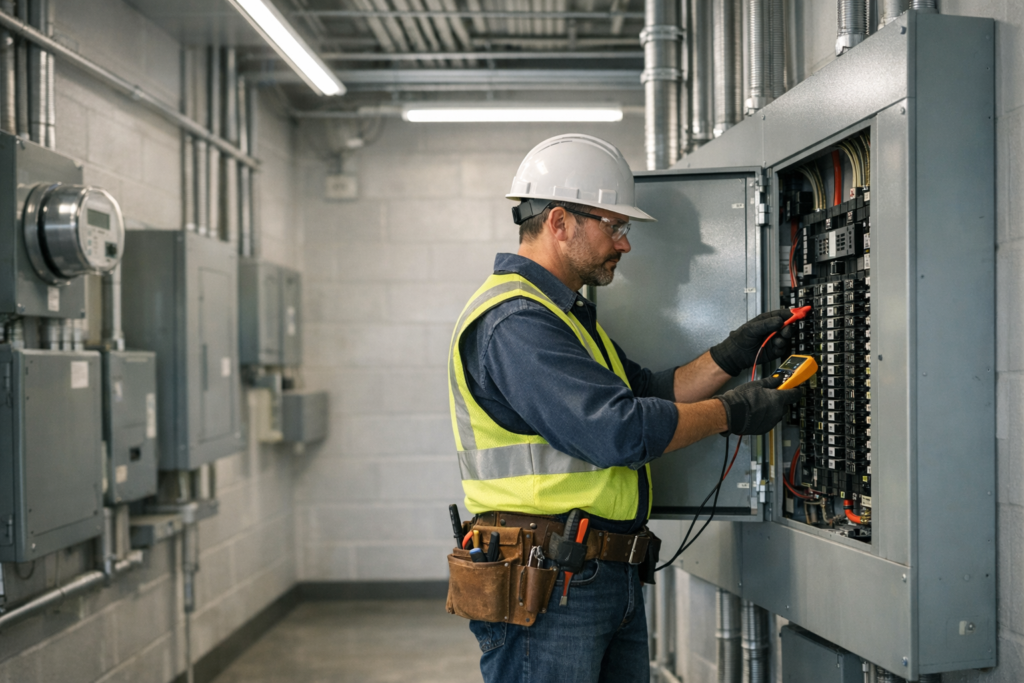
Preventative maintenance may include visual inspections, panel evaluations, thermal imaging where appropriate, breaker and connection checks, lighting system reviews, emergency system testing, and documentation updates. The right maintenance program depends on the building type, electrical load, equipment complexity, and operating schedule.
Rewiring And Circuit Modernization
Older commercial buildings often have wiring that was installed for a very different era of electrical demand. Over time, spaces are renovated, tenants change, equipment is added, and circuits may be extended or modified. Eventually, the wiring layout may no longer match how the building is used.
Rewiring or circuit modernization can improve safety, efficiency, and serviceability. It can also reduce the need for temporary fixes such as extension cords, overloaded power strips, or equipment sharing circuits that should be separated.
This is especially important in older and historic properties common throughout New England, where electrical systems may have been updated in stages over many decades. A professional evaluation can determine whether selective circuit upgrades or more comprehensive rewiring is appropriate.
Exterior And Parking Lot Lighting Improvements
Exterior lighting is a major opportunity for energy efficiency and safety. Parking lots, loading areas, building entrances, signage areas, walkways, and service doors often operate for long hours after dark. Older exterior fixtures can consume significant energy and require frequent maintenance.
LED exterior lighting, photocells, timers, motion-based controls, and properly aimed fixtures can reduce waste while improving visibility. Good design also helps minimize glare, dark spots, and unnecessary light spill.
For property managers and commercial owners, exterior lighting upgrades can support safety, tenant satisfaction, customer experience, and maintenance efficiency.
Common Mistakes To Avoid With Commercial Electrical Upgrades
Energy-efficient improvements work best when they are planned as part of a larger electrical strategy. Rushing into upgrades without evaluating the existing system can lead to performance issues or unnecessary costs.
Common mistakes include:
- Replacing fixtures without checking wiring, controls, or lighting layout
- Adding equipment without confirming available electrical capacity
- Ignoring recurring breaker trips or flickering lights
- Choosing the lowest-cost equipment without considering long-term reliability
- Failing to plan for future EV charging, tenant improvements, or equipment expansion
- Overlooking surge protection and power quality
- Postponing maintenance until a failure occurs
Electrical safety warning: Commercial electrical work should be performed by qualified, licensed electricians. Improper installation can create fire hazards, shock risks, code issues, equipment damage, and costly downtime.
How To Prioritize Electrical Upgrades For Your Building
The best starting point is a professional electrical assessment. Every commercial building has different needs based on age, occupancy, equipment, operating hours, electrical capacity, and business goals.
A practical priority list often starts with safety and reliability, then moves toward efficiency and future planning:
- Identify urgent safety concerns, damaged equipment, or overloaded circuits.
- Evaluate the electrical panel, service capacity, and load distribution.
- Review lighting systems and controls for energy-saving opportunities.
- Assess power quality, surge protection, and sensitive equipment needs.
- Plan for future loads such as EV chargers, HVAC upgrades, tenant buildouts, or expansion.
- Create a maintenance plan to protect the improvements over time.
This approach helps avoid piecemeal upgrades and creates a more dependable electrical system that supports the building for years to come.
Questions To Ask Before Starting A Commercial Electrical Upgrade
Before investing in commercial electrical upgrades, building owners and managers should ask practical questions that help clarify scope, budget, and long-term value.
- Is the existing electrical service adequate for current and future loads?
- Which areas of the building use the most energy?
- Are lighting levels appropriate for safety, work quality, and customer experience?
- Are there recurring electrical issues that indicate deeper problems?
- Will upcoming renovations, tenant changes, or equipment purchases affect the electrical system?
- Does the building need surge protection, generator readiness, or EV charging capacity?
- How can upgrades be phased to reduce disruption to business operations?
These questions help align electrical improvements with the way the property actually operates.
Work With An Experienced Commercial Electrical Contractor
Energy-efficient electrical upgrades require more than installing new equipment. They require proper evaluation, design, installation, testing, and long-term planning. The right electrical contractor will consider safety, capacity, code considerations, equipment compatibility, maintenance access, and future growth.
Electrical Constructors LLC provides residential, commercial, industrial, and new construction electrical services throughout New Hampshire, Massachusetts, Maine, and Vermont. From panel upgrades and lighting installations to EV chargers, generators, troubleshooting, preventative maintenance, and complete electrical system installations, our team helps property owners make informed decisions that support efficiency and reliability.
If your commercial building is using more energy than expected, experiencing recurring electrical issues, or preparing for future equipment demands, a professional electrical assessment is the right place to start. Well-planned commercial electrical upgrades can reduce wasted energy, improve system performance, and make your facility better prepared for the years ahead.