Commercial electrical maintenance saves money by finding small problems before they become emergency repairs, equipment failures, safety hazards, code issues, or business interruptions. For commercial buildings, the real cost of electrical neglect is rarely just the repair bill. It can include lost productivity, damaged equipment, tenant complaints, spoiled inventory, downtime, insurance complications, and rushed after-hours service calls.
The Real Cost of Ignoring Commercial Electrical Systems
Most commercial electrical problems do not appear overnight. Loose connections, overloaded circuits, worn components, failing breakers, heat buildup, corroded equipment, poor labeling, and outdated panels often develop gradually. Without routine inspections, these issues can remain hidden until something shuts down, trips repeatedly, overheats, or fails completely.
For business owners, property managers, contractors, and facility managers, that delay can be expensive. A single electrical failure may affect lighting, security systems, refrigeration, HVAC equipment, office technology, point-of-sale systems, production equipment, elevators, fire alarm interfaces, or tenant spaces. Even a short outage can disrupt schedules and create real financial loss.
Commercial electrical maintenance is designed to reduce that risk. Instead of waiting for failure, a qualified electrician evaluates the system, identifies warning signs, corrects deficiencies, and helps keep the electrical infrastructure dependable.
How Preventive Electrical Maintenance Saves Thousands
The biggest savings often come from preventing avoidable events. Emergency electrical repairs typically cost more than planned service, especially when work must be performed after hours, during a shutdown, or under pressure to restore operations quickly. Preventive maintenance gives building owners more control over timing, budgeting, and decision-making.
Proactive service can help reduce costs by:
- Finding loose or deteriorated electrical connections before they overheat
- Identifying overloaded circuits before breakers fail or nuisance tripping disrupts operations
- Extending the useful life of panels, switchgear, lighting systems, and electrical equipment
- Reducing the likelihood of unplanned downtime
- Helping avoid damage to sensitive electronics and mechanical equipment
- Supporting safer conditions for employees, tenants, customers, and maintenance staff
- Providing documentation that helps with budgeting, planning, and property management
For many facilities throughout New Hampshire, Massachusetts, Maine, and Vermont, older buildings, seasonal weather, and increased electrical demand make maintenance especially important. A building that performed well ten years ago may now be supporting LED retrofits, EV charging, added HVAC loads, upgraded security systems, server equipment, or tenant improvements that were never part of the original design.
What Commercial Electrical Maintenance Typically Includes
Every building is different, so maintenance should be based on the facility type, age, equipment, occupancy, operating hours, and electrical load. A retail building, warehouse, office property, restaurant, medical facility, industrial space, and multi-tenant commercial building can all have very different electrical priorities.
A well-planned commercial electrical maintenance program may include:
- Electrical panel and distribution equipment inspection
- Breaker and circuit evaluation
- Inspection for overheating, discoloration, corrosion, or damaged components
- Testing and troubleshooting of recurring electrical issues
- Lighting system inspection and repair recommendations
- Emergency and exit lighting checks where applicable
- Generator and transfer switch evaluation when installed
- Surge protection assessment
- Review of grounding and bonding concerns
- Evaluation of electrical rooms for access, organization, and safety concerns
- Identification of outdated, damaged, or improperly modified equipment
- Recommendations for repairs, upgrades, or further testing
The goal is not simply to create a checklist. The goal is to understand how the building is actually being used and whether the electrical system is still supporting that use safely and reliably.
Common Electrical Problems Found During Maintenance
Routine electrical inspections often reveal issues that building owners did not know existed. Some are minor and inexpensive to correct. Others are early indicators of more serious trouble.
Loose Connections
Loose electrical connections can create heat, arcing, intermittent power issues, and equipment damage. They are one of the most important concerns to identify early because they may not cause obvious symptoms until the condition becomes severe.
Overloaded Circuits
Commercial properties often evolve over time. New office equipment, appliances, tenant improvements, machinery, lighting, and HVAC changes can place additional demand on older circuits. If a circuit is repeatedly overloaded, the building may experience tripped breakers, warm equipment, flickering lights, or premature component failure.
Outdated Panels and Distribution Equipment
Older electrical panels may lack capacity for modern business needs or may contain worn components that are difficult to service. Maintenance helps determine whether repair is appropriate or whether a panel upgrade, service upgrade, or planned replacement would be more reliable long term.
Poor Labeling
Inaccurate or missing panel schedules waste time during troubleshooting and can create safety concerns. Clear labeling allows electricians and facility staff to respond more efficiently during repairs, renovations, tenant work, or emergencies.
Moisture and Corrosion
New England buildings face snow, ice, freeze-thaw cycles, roof leaks, humidity, and coastal or damp conditions in some areas. Moisture around electrical equipment can accelerate corrosion and create unsafe conditions. Maintenance helps identify water intrusion before it leads to more extensive damage.
Improper Modifications
Commercial properties often go through multiple tenants, renovations, and equipment changes. Over time, electrical work may have been added, abandoned, or modified. A qualified electrician can identify unsafe or poorly executed work and recommend corrections.
Downtime Is Often More Expensive Than the Repair
An electrical repair may cost hundreds or thousands of dollars, but downtime can cost far more. If a restaurant loses refrigeration, a retail store loses lighting and point-of-sale systems, an office loses network equipment, or a warehouse loses power to loading and security systems, the impact extends beyond the electrical room.
Planned maintenance helps reduce surprise failures and allows repairs to be scheduled at less disruptive times. For property managers, that may mean coordinating work around tenant hours. For manufacturers or warehouses, it may mean planning service during scheduled downtime. For office buildings, it may mean avoiding disruptions during peak business hours.
This scheduling control is one of the most overlooked financial benefits of commercial electrical maintenance. When electrical work is planned, building owners can compare options, phase repairs, prepare occupants, and avoid rushed decisions.
Electrical Maintenance Supports Safety and Risk Reduction
Electrical safety is one of the most important reasons to maintain a commercial building. Problems such as overheating panels, damaged wiring, exposed conductors, improper temporary wiring, overloaded equipment, or deteriorated electrical components can create serious hazards.
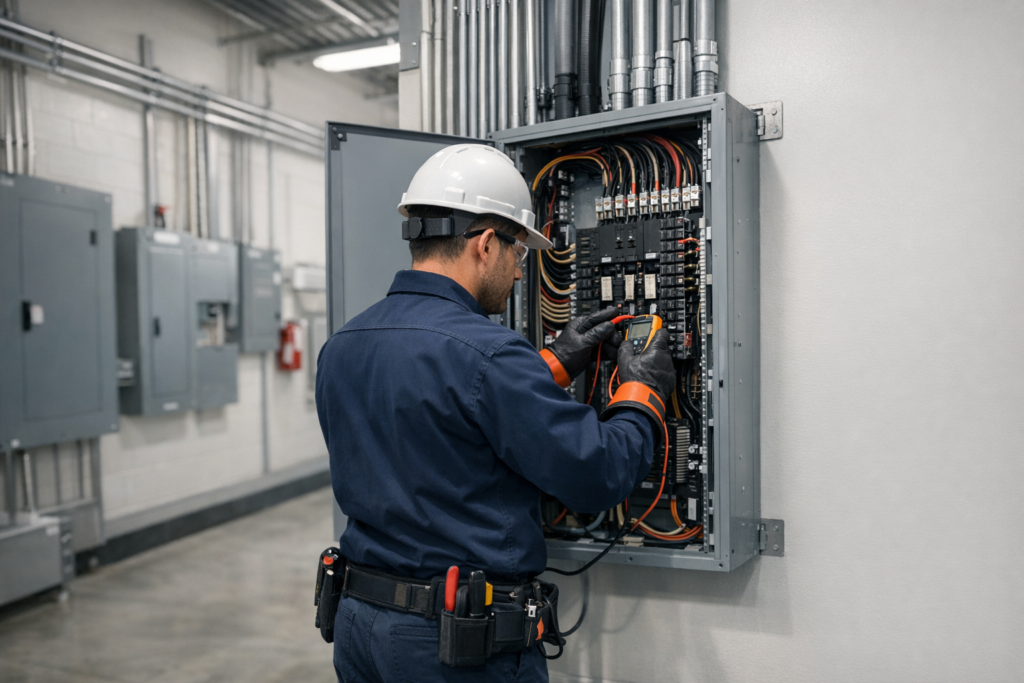
Commercial electrical systems should only be inspected, repaired, or modified by qualified licensed electricians. Electrical panels, service equipment, and distribution systems can present shock, arc flash, and fire risks when handled improperly.
Routine maintenance can help identify conditions that may increase risk, including:
- Burn marks or discoloration around breakers and electrical equipment
- Buzzing, crackling, or unusual odors near panels or devices
- Frequent breaker trips or unexplained power loss
- Warm outlets, switches, or equipment enclosures
- Damaged conduit, wiring, covers, or junction boxes
- Improper extension cord use or temporary wiring
- Blocked electrical panels or equipment access
These issues should not be ignored. A maintenance visit gives property owners a professional evaluation and a practical path for correcting unsafe conditions.
Code Corrections and Compliance Considerations
Electrical codes exist to support safety, and commercial properties often face added scrutiny during renovations, tenant build-outs, equipment upgrades, insurance reviews, and property transactions. While specific code requirements vary by project and jurisdiction, a licensed electrical contractor can identify visible concerns and explain when additional evaluation, permitting, or correction may be needed.
Commercial electrical maintenance is not a substitute for every specialized inspection, but it can reveal conditions that deserve attention before they become urgent. This is especially useful for older buildings, properties with multiple renovations, and facilities where electrical documentation is incomplete.
For building owners and property managers, addressing electrical deficiencies proactively can make future projects smoother. It can also help prevent last-minute surprises when a tenant improvement, service upgrade, generator installation, EV charger project, or equipment installation is underway.
Maintenance Helps Extend the Life of Electrical Equipment
Electrical equipment lasts longer when it is properly installed, correctly loaded, protected from moisture, kept clean and accessible, and inspected periodically. Heat, vibration, corrosion, dust, excessive load, and poor connections all shorten equipment life.
Preventive maintenance can help protect:
- Electrical panels and breakers
- Switchgear and distribution equipment
- Transformers
- Lighting systems and controls
- Motors and mechanical equipment circuits
- Generator connections and transfer equipment
- Surge protection devices
- Dedicated circuits for critical business equipment
Replacing major electrical equipment unexpectedly can be expensive and disruptive. A maintenance program helps owners understand which components are in good condition, which need repair, and which should be planned for future replacement.
Energy Efficiency Opportunities Found During Maintenance
Commercial electrical maintenance is not only about preventing failures. It can also reveal opportunities to reduce energy waste and improve building performance. Many commercial buildings still operate with outdated lighting, inefficient controls, poorly balanced loads, or equipment that no longer matches the way the space is used.
During maintenance, an electrician may identify opportunities such as:
- Upgrading outdated lighting to efficient LED systems
- Adding occupancy sensors, timers, or lighting controls
- Correcting circuits that are poorly organized or overloaded
- Improving exterior lighting reliability and security
- Planning electrical capacity for future EV charging or equipment upgrades
- Evaluating surge protection for sensitive electronics
Energy savings vary by building and system, but efficiency improvements often provide value beyond utility costs. Better lighting can improve visibility, exterior safety, tenant satisfaction, and the overall appearance of a commercial property.
New England Weather Makes Electrical Reliability Even More Important
Businesses and commercial properties across New Hampshire, Massachusetts, Maine, and Vermont deal with demanding seasonal conditions. Winter storms, heavy snow, ice, wind, and extended cold weather can all affect electrical reliability. Power outages can also place added demand on generators, transfer switches, battery backups, heating systems, sump pumps, communication equipment, and security systems.
Preventive maintenance helps prepare buildings before severe weather exposes weak points. That may include checking generator readiness, evaluating exterior electrical equipment, reviewing critical circuits, inspecting signs of moisture intrusion, and identifying aging components that could fail under stress.
For facilities where downtime is not acceptable, seasonal electrical maintenance should be part of broader operational planning. Waiting until the first major storm is rarely the most cost-effective strategy.
How Often Should a Commercial Electrical System Be Maintained?
There is no single maintenance schedule that fits every commercial property. The right frequency depends on the building type, electrical load, equipment age, environment, occupancy, and business risk. A small office with a relatively simple electrical system may not need the same schedule as a manufacturing facility, restaurant, medical office, or multi-tenant commercial building.
In general, building owners should consider more frequent electrical maintenance when:
- The building has older electrical panels or wiring
- Breakers trip repeatedly
- Lighting problems occur often
- The property has experienced renovations or tenant changes
- Critical equipment depends on uninterrupted power
- The building uses generators, transfer switches, or specialized equipment
- Moisture, dust, vibration, heat, or harsh conditions are present
- Future upgrades, expansions, or EV charger installations are being planned
A licensed commercial electrician can recommend a practical maintenance interval after evaluating the property and understanding how the facility operates.
Signs Your Building Needs Electrical Maintenance Now
Some warning signs should prompt a professional evaluation sooner rather than later. If any of the following are happening in your commercial property, it is time to schedule service:
- Frequent breaker trips or unexplained outages
- Flickering, dimming, or buzzing lights
- Warm panels, outlets, switches, or equipment
- Burning smells or discoloration near electrical devices
- Outdated or overcrowded electrical panels
- Extension cords being used as permanent wiring
- Equipment shutting down unexpectedly
- Tenants reporting recurring electrical problems
- Electrical rooms that are cluttered, unlabeled, or difficult to access
- Planned renovations, new equipment, or increased electrical demand
These symptoms may indicate anything from a simple repair to a more serious system issue. Proper troubleshooting helps determine the cause instead of simply treating the symptom.
Maintenance Is Especially Valuable for Property Managers and Facility Teams
Property managers and facility managers are often responsible for controlling costs, limiting tenant disruptions, and managing long-term building performance. Commercial electrical maintenance supports all three goals.
A documented maintenance program helps management teams prioritize repairs, plan capital improvements, respond to tenant concerns, and reduce emergency calls. It also gives decision-makers a clearer picture of the condition of the building’s electrical infrastructure.
For multi-tenant properties, maintenance can be particularly valuable because electrical problems in one area may affect multiple occupants. Clear documentation, organized panels, and proactive troubleshooting make future service faster and more efficient.
Planned Electrical Work Protects Your Budget
Unexpected electrical failures force immediate decisions. Planned maintenance gives owners time to budget properly, compare repair options, coordinate outages, order equipment, and complete work with less disruption. That financial predictability is one of the strongest reasons to invest in preventive service.
Commercial electrical maintenance can also help identify which upgrades are urgent and which can be phased over time. For example, a building may need immediate correction of a damaged component while planning a future panel upgrade, lighting project, generator installation, or service expansion.
This approach helps avoid the costly cycle of emergency repairs followed by short-term fixes that do not address the underlying condition of the electrical system.
What to Expect From a Qualified Commercial Electrician
A qualified commercial electrical contractor should do more than glance at a panel and leave a bill. The electrician should evaluate the system carefully, communicate clearly, explain concerns in understandable terms, and recommend practical next steps.
During a commercial electrical maintenance visit, you should expect:
- A professional review of accessible electrical equipment
- Attention to safety concerns and obvious failure points
- Clear explanation of observed issues
- Recommendations based on priority and risk
- Discussion of repair, replacement, or upgrade options when appropriate
- Respect for business operations, tenants, and scheduling needs
The best maintenance relationship is collaborative. The electrician brings technical expertise, while the business owner or facility team provides insight into how the building operates, which systems are critical, and where recurring problems have occurred.
Commercial Electrical Maintenance Is an Investment in Reliability
Electrical systems are easy to overlook when everything appears to work. But for commercial buildings, reliability depends on what is happening behind the walls, inside panels, above ceilings, in electrical rooms, and at critical equipment connections.
Consistent commercial electrical maintenance helps prevent costly failures, improve safety, extend equipment life, support energy efficiency, and protect daily operations. For businesses and property owners throughout New Hampshire, Massachusetts, Maine, and Vermont, it is one of the most practical ways to reduce risk and control long-term electrical costs.
Electrical Constructors LLC provides experienced residential, commercial, industrial, and new construction electrical services, including troubleshooting, repairs, panel upgrades, service upgrades, lighting, generators, EV chargers, inspections, code corrections, and preventative maintenance. For commercial properties, proactive electrical care can make the difference between a planned repair and an expensive interruption.