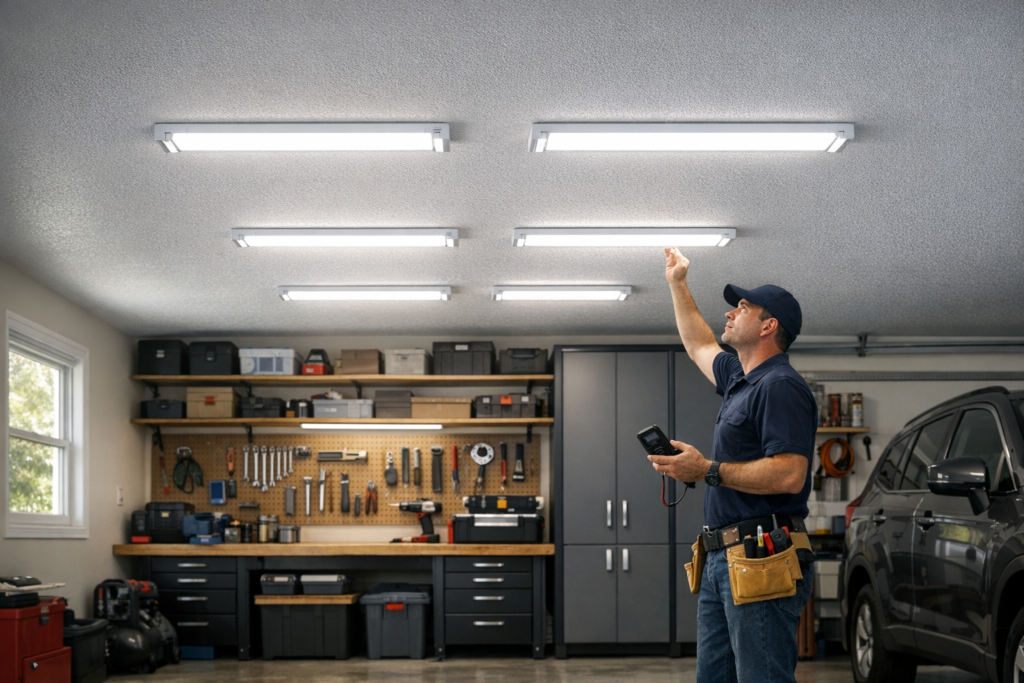
Garage LED lighting is one of the most practical upgrades for homeowners, contractors, mechanics, hobbyists, and property owners who want a safer, brighter, and more efficient workspace. Compared with older fluorescent or incandescent fixtures, properly selected LED lights can improve visibility, reduce energy use, perform better in cold weather, and make garages and workshops easier to use year-round.
Whether the space is a residential garage in New Hampshire, a maintenance bay in Massachusetts, a workshop in Maine, or a commercial service area in Vermont, the right lighting design affects more than comfort. It influences safety, productivity, electrical reliability, and how well the space supports the work being done.
Why Garage and Workshop Lighting Deserves More Attention
Garages and workshops are often asked to do much more than store vehicles. They may serve as repair areas, woodworking shops, home gyms, storage rooms, hobby spaces, loading areas, mechanical rooms, or small commercial work zones. Unfortunately, many of these spaces still rely on a single ceiling bulb, aging fluorescent strips, or fixtures that were never designed for detailed work.
Poor lighting creates real problems. Shadows make it harder to read labels, inspect equipment, find tools, identify wiring colors, park safely, or notice trip hazards. In a workshop, dim or uneven light can affect cut accuracy, repair quality, and personal safety. In a commercial garage or maintenance area, inadequate lighting can slow work and increase the chance of mistakes.
LED lighting solves many of these problems because it delivers strong, efficient, directional light in fixture styles designed for task areas, vehicle bays, storage zones, and high-use workspaces.
The Main Benefits of Garage LED Lighting
Better Visibility for Detailed Work
LED fixtures provide clean, consistent light that makes it easier to see fine details. This matters when you are working under a hood, using power tools, reading small markings, sorting hardware, inspecting equipment, or completing precision tasks.
Many older garage lights create uneven brightness, with bright spots directly under the fixture and dark corners around the room. A properly planned LED layout can spread light more evenly across the entire space, reducing shadows and making the garage feel larger and more usable.
Improved Safety
Good lighting is a safety feature. Brighter, well-placed fixtures help people see extension cords, steps, wet floors, tools, vehicle edges, stored materials, and overhead obstructions. This is especially important in garages and workshops where floors may be crowded, surfaces may be uneven, and work often happens around sharp tools or moving equipment.
For commercial and industrial spaces, improved lighting can also support safer movement for employees, vendors, and customers. While lighting alone does not eliminate workplace hazards, it plays an important role in making hazards easier to recognize.
Lower Energy Use
LED lighting typically uses significantly less electricity than older incandescent lighting and often less than traditional fluorescent fixtures. For a homeowner who uses the garage occasionally, the savings may be modest but still worthwhile. For a business, maintenance shop, storage facility, or multi-bay garage where lights operate for long hours, energy savings can become much more meaningful over time.
LEDs also pair well with occupancy sensors, dimmers, daylight controls, and zoning strategies when the fixtures and controls are compatible. That allows lights to operate only where and when they are needed.
Longer Fixture Life and Less Maintenance
Changing burned-out bulbs in a garage is inconvenient. In commercial spaces with high ceilings, lifts, storage racks, or vehicle bays, lighting maintenance can be disruptive. LED fixtures generally last much longer than incandescent lamps and many older fluorescent systems, which means fewer replacements and less downtime.
For property managers and facility teams, reduced maintenance is often one of the most valuable benefits of upgrading to LED shop lighting. Fewer service interruptions help keep work areas safer and more productive.
Better Cold-Weather Performance
Cold New England weather can be hard on older lighting, particularly certain fluorescent fixtures that flicker, buzz, or take time to reach full brightness in unheated garages. Quality LED fixtures are available in models designed to perform well in colder environments, making them a strong choice for garages, barns, workshops, utility buildings, and storage areas throughout New Hampshire, Massachusetts, Maine, and Vermont.
If your existing lights are slow to start on winter mornings, flicker when temperatures drop, or seem dim until the space warms up, an LED lighting upgrade may make the garage more dependable during the months when you need it most.
What Makes a Good LED Garage Lighting Plan?
The best garage LED lighting is not simply the brightest light available. A good layout considers the size of the space, ceiling height, work zones, fixture type, color quality, switching, and the condition of the existing electrical system.
Lumens Matter More Than Watts
With older lighting, many people judged brightness by wattage. With LEDs, wattage tells you energy use, not brightness. The more useful measurement is lumens, which describe how much visible light the fixture produces.
A garage used only for parking may need less light than a workshop used for woodworking, mechanical repair, electrical assembly, or commercial maintenance. Task-heavy spaces usually benefit from higher light output and more even coverage rather than one extremely bright fixture in the center of the room.
Color Temperature Affects Usability
Color temperature describes whether light appears warm, neutral, or cool. Many garages and workshops perform well with neutral white or cool white lighting because it creates a clean, alert environment and improves visibility for task work.
Very warm light can feel comfortable but may appear too dim or yellow for detailed work. Very cool light can be bright but may feel harsh if overused. The right choice depends on how the space is used and the preferences of the people working there.
Color Rendering Helps With Detail
Color rendering refers to how accurately a light source shows colors. In a garage or workshop, this can matter when identifying wire colors, matching paint, inspecting fluids, sorting materials, reading labels, or working on finishes. Fixtures with better color rendering can make the space more functional and reduce eye strain during detailed tasks.
Fixture Placement Reduces Shadows
One common mistake is installing one bright fixture in the middle of the garage and expecting it to solve every lighting problem. Central fixtures often cast shadows when a vehicle, person, garage door opener, shelving, or overhead storage blocks the light.
A better design may use several fixtures spread across the ceiling, with additional task lighting above workbenches, equipment areas, or storage zones. In commercial garages, lighting should account for vehicle bays, lifts, service benches, walkways, and overhead doors.
LED Lighting Options for Garages and Workshops
LED Strip and Linear Fixtures
Linear LED fixtures are a popular replacement for fluorescent shop lights. They work well in garages, utility areas, storage rooms, mechanical spaces, and workshops because they distribute light across a wide area. They are often a good fit for long workbenches, vehicle bays, and rectangular rooms.
LED Shop Lights
LED shop lights are designed for practical workspaces and can provide strong overhead illumination. Some are plug-in models, while others are hardwired. Plug-in fixtures may be convenient in certain applications, but permanent workspaces often benefit from professionally installed hardwired lighting that is cleaner, more reliable, and properly controlled.
Vapor-Tight and Damp-Location Fixtures
Garages can experience moisture from snow, rain, humidity, vehicle runoff, and temperature swings. In areas where moisture, dust, or debris are concerns, vapor-tight or damp-location rated LED fixtures may be appropriate. The rating and fixture selection should match the environment where the light will be installed.
High Bay LED Lighting
Commercial garages, warehouses, farm buildings, and large workshops with higher ceilings may require high bay LED fixtures. These fixtures are designed to deliver light from greater heights and can be selected with beam patterns suited to the space. Proper placement is important because overly bright or poorly aimed high bay lights can create glare.
Task Lighting
Task lighting supplements general overhead lighting. Examples include lights above workbenches, tool stations, inspection areas, equipment benches, and assembly tables. This type of lighting helps reduce shadows where precision matters most.
Residential Garage LED Lighting Considerations
For homeowners, a garage lighting upgrade can make daily routines easier. Backing into the garage, loading tools, organizing storage, working on weekend projects, and finding seasonal items all become easier with better illumination.
Older New England homes often have garages with limited outlets, older switches, undersized lighting circuits, or fixtures added over time without much planning. Before adding multiple new lights, it is wise to have the electrical system evaluated by a qualified electrician. The goal is not only more light, but safe, dependable power for the way the garage is actually used.
Homeowners should also think about future needs. If the garage may later support an EV charger, generator connection equipment, a workshop subpanel, additional outlets, or dedicated tool circuits, lighting upgrades may be a good time to discuss broader electrical planning.
Commercial Garage and Workshop Lighting Considerations
Commercial spaces often require a more deliberate lighting approach because the lights may operate for many hours each day and need to support employee productivity, safety, and workflow. Auto service bays, maintenance shops, contractor garages, storage facilities, and industrial work areas all have different needs.
Business owners and facility managers should consider:
- Ceiling height and fixture mounting options
- Vehicle bay layout and lift locations
- Workbench and equipment placement
- Glare control for employees working upward or under vehicles
- Moisture, dust, vibration, and temperature exposure
- Switching zones for different work areas
- Emergency lighting and other life-safety systems where applicable
- Electrical capacity and condition of existing circuits
A professional electrical contractor can help determine whether the current wiring, panels, controls, and fixture locations are appropriate for the new lighting system.
Common Mistakes to Avoid With Garage LED Lighting
LED lighting is efficient and versatile, but the results depend on proper selection and installation. Avoiding a few common mistakes can make the difference between a garage that feels professionally lit and one that is simply brighter than before.
- Choosing fixtures based only on brightness: Too much light in the wrong location can cause glare, harsh shadows, and visual discomfort.
- Ignoring fixture ratings: Garages may need fixtures suitable for damp, dusty, cold, or rugged environments.
- Using poor-quality products: Low-quality LED fixtures can flicker, fail early, produce uneven color, or create radio interference.
- Overloading existing circuits: LEDs use less power, but the overall electrical system still needs to be evaluated before adding equipment.
- Forgetting task areas: General overhead lighting may not be enough for benches, machinery, tool walls, or inspection zones.
- Mixing incompatible controls: Not all LED fixtures work properly with every dimmer, sensor, or timer.
When Should You Replace Older Garage Lights?
You may benefit from a garage LED lighting upgrade if your current fixtures flicker, hum, start slowly, leave dark corners, produce excessive glare, or fail frequently. Replacement may also make sense if you are remodeling a garage, adding a workshop, improving a commercial service area, preparing a property for tenants, or trying to reduce energy use.
Other signs it may be time to call an electrician include warm switch plates, damaged wiring, outdated fixtures, tripping breakers, lights that dim when tools start, or extension cords being used as a permanent solution. These issues may point to electrical concerns beyond lighting and should be evaluated by a licensed professional.
Safety and Code Considerations
Electrical work in garages and workshops should be handled carefully because these spaces often include power tools, stored materials, vehicles, moisture, temperature changes, and heavy equipment. Fixture placement, wiring methods, grounding, circuit protection, and control locations all matter.
Do not attempt electrical work that is beyond your training or experience. Installing hardwired light fixtures, modifying circuits, adding switches, working in electrical panels, or troubleshooting wiring problems should be performed by a qualified electrician. A professional can help ensure the installation is safe, dependable, and appropriate for the space.
Electrical requirements can vary based on the property, building type, project scope, and local authority having jurisdiction. A licensed electrical contractor can evaluate the existing conditions and complete the work according to applicable standards.
Energy Efficiency and Long-Term Value
The value of garage LED lighting goes beyond the monthly electric bill. A well-designed lighting system can improve how the space functions every day. It can reduce maintenance, support safer work habits, extend usable hours during short winter days, and make the garage or workshop more appealing to occupants, employees, or tenants.
In commercial settings, lighting upgrades may also support a cleaner, more professional appearance for customers and staff. In residential spaces, strong and even LED lighting can make a garage feel less like a storage area and more like a usable extension of the home.
How Electrical Constructors LLC Can Help
Electrical Constructors LLC provides residential, commercial, industrial, and new construction electrical services throughout New Hampshire, Massachusetts, Maine, and Vermont. The team can evaluate your existing garage or workshop lighting, recommend practical LED fixture options, upgrade wiring where needed, install new controls, and help design a lighting layout that supports the way you use the space.
From a single residential garage to a multi-bay commercial workshop, a professional LED lighting installation can make the space safer, brighter, more efficient, and easier to maintain. If your garage lighting is outdated, unreliable, or simply not doing the job, upgrading to modern LED fixtures is a smart place to start.