
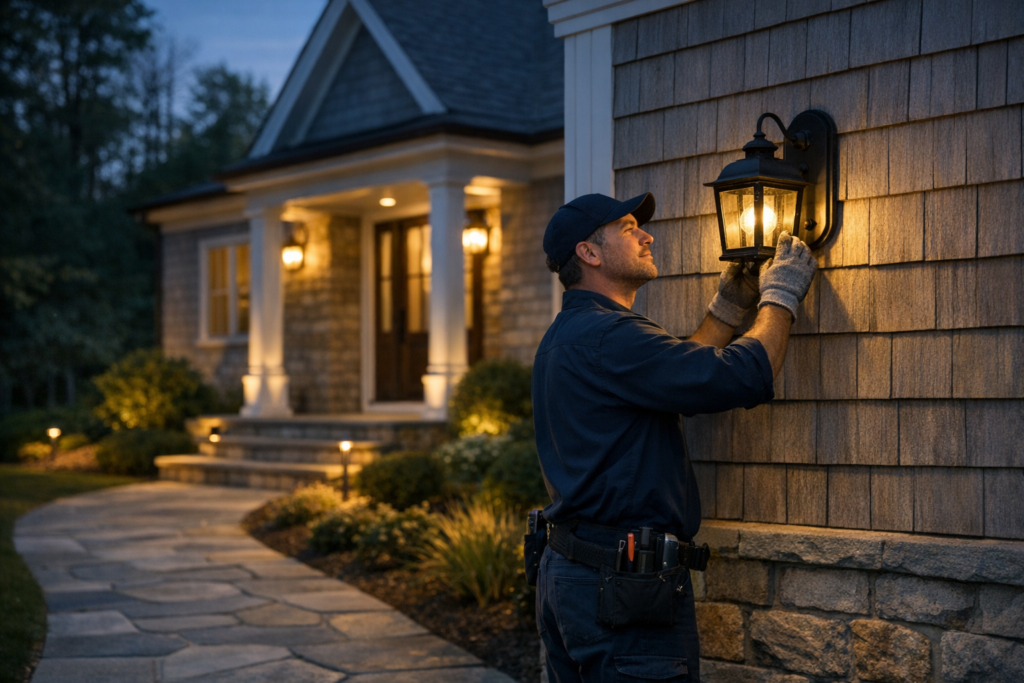
The best exterior lighting does more than make a property look attractive after dark. A well-planned system improves safety, supports security, increases usable outdoor space, highlights architecture, and helps visitors, customers, tenants, and family members move around with confidence. Whether you own a home, manage a commercial building, or oversee a new construction project, professional exterior lighting installation should be designed around how the property is actually used, not just how the fixtures look in a catalog.
What Exterior Lighting Should Accomplish
Effective exterior lighting balances visibility, safety, appearance, efficiency, and durability. A front entry light, parking lot fixture, pathway light, building-mounted wall pack, landscape accent light, and motion-activated security light each serve a different purpose. Choosing the right mix helps avoid dark spots, glare, wasted energy, and premature fixture failure.
For properties throughout New Hampshire, Massachusetts, Maine, and Vermont, exterior lighting also needs to be selected with New England conditions in mind. Snow, ice, wind, changing temperatures, coastal moisture in some areas, and long winter nights can all affect fixture placement, material selection, wiring methods, and long-term performance.
Start With the Purpose of Each Lighting Area
Before choosing fixtures, identify what each part of the property needs to achieve. Exterior lighting should be planned by zone so each area receives the right amount of illumination without overlighting the entire property.
- Entrances: Front doors, side doors, service doors, and loading areas need reliable illumination for safe access and visibility.
- Walkways and stairs: Path lighting helps reduce trip hazards and makes elevation changes easier to see.
- Driveways and parking areas: Proper fixture placement improves vehicle and pedestrian safety while helping reduce dark corners.
- Decks, patios, and outdoor gathering areas: Comfortable lighting extends usability without creating harsh glare.
- Building perimeters: Security-focused lighting supports cameras, deters unwanted activity, and improves nighttime awareness.
- Landscaping and architecture: Accent lighting highlights features while adding curb appeal and visual depth.
This planning step is especially important for commercial properties, multifamily buildings, retail locations, offices, industrial facilities, and managed properties where safety, liability, visibility, and maintenance access matter every day.
Common Types of Exterior Lighting Fixtures
Exterior fixtures are not interchangeable. Each type is designed for a specific mounting location, light pattern, output level, and environmental exposure. Understanding the major categories helps property owners make better decisions before moving forward with exterior lighting installation.
Wall-Mounted Lights
Wall-mounted fixtures are commonly used near entrances, garages, service doors, side doors, loading areas, and building perimeters. Residential properties often use decorative sconces or lantern-style fixtures, while commercial buildings may use wall packs or architectural fixtures designed for broader coverage.
The key is selecting a fixture that provides enough light without shining directly into windows, neighboring properties, or drivers’ eyes. Poorly aimed wall lights can create glare while still leaving walking surfaces underlit.
Pathway and Walkway Lighting
Pathway lights improve safety along sidewalks, garden paths, stairs, and landscaped areas. These fixtures should guide people naturally through the property. In snowy climates, fixture height and placement matter because low fixtures can become buried, damaged by shoveling, or blocked by snowbanks.
Floodlights and Security Lights
Floodlights can illuminate driveways, yards, storage areas, building corners, and service zones. Motion sensors and timers can make them more efficient and less intrusive. However, brighter is not always better. Excessive brightness can create harsh contrast, deep shadows, and unnecessary light spill.
Landscape and Accent Lighting
Landscape lighting is used to highlight trees, stonework, signs, architectural details, garden beds, retaining walls, and focal points. It can add significant curb appeal, but it should still be installed with proper outdoor-rated wiring, weather-resistant equipment, and safe transformer placement when low-voltage systems are used.
Parking Lot and Area Lighting
Commercial parking lots, private roads, loading areas, and large paved surfaces require careful layout. Pole lights, canopy lights, and area fixtures should be selected based on mounting height, beam spread, fixture spacing, and intended use. The goal is even coverage, not random brightness.
Deck, Patio, and Step Lighting
Outdoor living spaces benefit from layered lighting. Step lights, rail lights, under-cap lights, and overhead fixtures can improve comfort and safety without making the space feel overlit. These fixtures must be appropriate for outdoor use and installed to withstand moisture exposure.
Key Factors When Choosing Exterior Lighting
A fixture may look attractive online or in a showroom, but appearance should only be one part of the decision. Long-term performance depends on electrical compatibility, weather resistance, fixture quality, control options, and installation conditions.
Brightness and Light Output
Exterior lights are commonly evaluated by lumens, which measure light output. More lumens mean more light, but the right amount depends on the application. A pathway needs gentle guidance. A commercial loading area needs stronger visibility. A front porch needs enough light for access, identification, and safety without glare.
Too little light creates unsafe areas. Too much light wastes energy and can make a property uncomfortable. A professional electrician can help determine where higher-output fixtures are useful and where lower-output or shielded fixtures would perform better.
Color Temperature
Color temperature affects how exterior lighting feels and performs. Warmer light often works well for residential entries, patios, and landscape accents because it feels inviting. Cooler light may be appropriate for certain commercial, parking, or security applications where visibility is the priority.
Consistency matters. Mixing too many color temperatures on one property can make the lighting look unplanned. For larger properties, a coordinated lighting plan creates a cleaner and more professional appearance.
Fixture Durability
Outdoor fixtures should be built for their environment. Moisture, freezing temperatures, UV exposure, insects, salt air in some areas, and repeated freeze-thaw cycles can shorten the life of poorly made fixtures. Look for properly rated outdoor fixtures, durable housings, quality lenses, and corrosion-resistant materials appropriate for the location.
Glare Control
Good lighting improves visibility. Bad lighting creates glare. Fixtures should place light where it is needed while limiting direct view of the light source. Shielded fixtures, proper aiming, and thoughtful placement can reduce eye strain, neighbor complaints, light trespass, and harsh shadows.
Controls and Automation
Exterior lighting can be controlled with switches, photocells, timers, motion sensors, smart controls, or building automation systems. The best control strategy depends on the property. A home may benefit from motion-activated driveway lights and dusk-to-dawn entry lighting. A commercial property may need scheduled controls, multiple lighting zones, and lighting tied into broader facility operations.
Why LED Lighting Is Often the Best Choice
LED exterior lighting is widely used because it offers strong energy efficiency, long service life, instant-on performance, and excellent control options. For homeowners and businesses, LED fixtures can reduce energy use while improving visibility when compared with older or inefficient lighting technologies.
LEDs are especially useful in New England because winter nights are long and outdoor lighting often runs for extended hours. Choosing quality LED fixtures can help reduce maintenance demands, particularly for hard-to-reach fixtures on commercial buildings, parking lots, and high exterior elevations.
When selecting LED fixtures, consider output, color temperature, fixture rating, lens design, and replaceability. Some integrated LED fixtures require full fixture replacement when they fail, while other designs allow easier maintenance. The right choice depends on budget, access, application, and long-term maintenance expectations.
Residential Exterior Lighting Considerations
For homes, exterior lighting should improve security, safety, curb appeal, and everyday convenience. Common residential exterior lighting projects include entry lighting, garage lighting, driveway lighting, patio lighting, deck lighting, landscape lighting, motion sensor lights, and lighting around detached garages or outbuildings.
Older homes throughout New Hampshire, Massachusetts, Maine, and Vermont may require additional evaluation before new fixtures are installed. Existing wiring, weatherproof boxes, grounding, circuit capacity, and switch locations should all be reviewed. Replacing an old fixture is not always as simple as attaching a new one, particularly when wiring is outdated, damaged, or not suited for the new load or location.
Homeowners should also think about daily routines. If guests often arrive after dark, entry and walkway lighting should be a priority. If the driveway is long or poorly lit, motion or dusk-to-dawn lighting may improve visibility. If outdoor entertaining is important, layered patio or deck lighting can make the space more useful and comfortable.
Commercial Exterior Lighting Considerations
Commercial exterior lighting must support safety, access, security, branding, and operational needs. Poorly lit parking areas, entrances, loading docks, signage, walkways, and service areas can create unnecessary risk and frustration for employees, customers, tenants, and vendors.
Business owners and property managers should evaluate exterior lighting during both daytime and nighttime conditions. During the day, an electrician can inspect fixture condition, mounting locations, wiring, controls, and equipment access. At night, it becomes easier to identify uneven coverage, failed fixtures, shadows, glare, and underlit pedestrian areas.
Commercial lighting projects may involve more complex coordination than residential work. Circuit capacity, control panels, contactors, emergency lighting considerations, exterior receptacles, signage circuits, tenant requirements, maintenance access, and future expansion should all be considered during planning.
Safety Issues to Avoid
Exterior lighting operates in demanding conditions. Moisture, temperature changes, physical damage, insects, and improper installation can lead to reliability and safety problems. Electrical work outdoors should be handled carefully because equipment is exposed to weather and often serves areas where people walk, drive, work, or gather.
- Do not use indoor-rated fixtures outside.
- Do not ignore flickering, buzzing, tripping breakers, or water inside fixtures.
- Do not overload existing circuits with additional lighting without evaluation.
- Do not run temporary extension cords as a permanent lighting solution.
- Do not install fixtures where snow removal equipment, vehicles, or doors can damage them.
- Do not assume old exterior wiring is safe just because the light still turns on.
Exterior electrical work should be performed by qualified, licensed electricians. Proper installation helps protect the property, supports code-compliant workmanship, and reduces the chance of shock hazards, equipment failure, and fire risks.
Planning for Winter Weather and Power Outages
New England properties face unique seasonal demands. Long winter nights increase the importance of dependable outdoor lighting. Snow and ice can block low-mounted fixtures, hide trip hazards, and make poorly lit stairs or walkways more dangerous. Wind and freezing rain can also test fixture mounts and weatherproof connections.
Exterior lighting should be placed where it remains effective after snowfall and where fixtures are protected from common sources of damage. For commercial properties, maintenance crews should be able to access fixtures safely when lamps, drivers, sensors, or components require service.
If a property relies on a standby generator, key exterior lighting circuits may be worth discussing during generator planning. Keeping critical entry, walkway, security, or commercial access lighting operational during an outage can make a major difference in safety and convenience.
How Professional Exterior Lighting Installation Works
A proper exterior lighting installation begins with evaluation and planning. The electrician should assess the property, existing electrical system, fixture locations, control needs, wiring routes, circuit capacity, and any visible safety concerns. For larger residential or commercial projects, the layout may involve multiple lighting zones and control strategies.
Professional installation may include mounting fixtures, installing weather-resistant boxes, adding or extending circuits, upgrading controls, installing sensors, configuring timers, evaluating grounding and bonding conditions, and testing each fixture after installation. The goal is not simply to make the lights turn on; the goal is to create a safe, durable, and reliable system.
For new construction, exterior lighting should be planned early with the builder, electrician, architect, or project team. Early coordination helps place wiring, switch legs, conduit, boxes, and controls correctly before finishes, siding, paving, or landscaping make changes more difficult and expensive.
Questions to Ask Before Choosing Fixtures
Before purchasing exterior lights, property owners should answer a few practical questions. These answers help determine the right fixtures, controls, wiring approach, and installation scope.
- What areas are currently too dark or unsafe at night?
- Is the goal safety, security, appearance, convenience, or all of the above?
- Will the lights operate all night, only on motion, or on a timer?
- Are existing fixtures failing, outdated, or inefficient?
- Is the current wiring in good condition and suitable for outdoor use?
- Will snow, landscaping, signage, doors, or vehicles interfere with fixture placement?
- Does the property need separate lighting zones?
- Will future additions, renovations, EV chargers, generators, or site improvements affect the electrical plan?
Answering these questions before installation helps prevent common mistakes such as poor placement, insufficient coverage, mismatched fixture styles, inconvenient controls, and electrical limitations that should have been addressed during planning.
When to Upgrade Existing Exterior Lighting
Exterior lighting should be upgraded when fixtures are damaged, inefficient, unreliable, unsafe, or no longer meeting the needs of the property. Warning signs include repeated bulb failures, flickering lights, rusted housings, cracked lenses, water intrusion, tripped breakers, buzzing sounds, dim output, exposed wiring, or controls that no longer work properly.
It may also be time to upgrade when a property changes use. A home addition, new patio, expanded driveway, renovated storefront, tenant change, parking lot improvement, or building addition can all create new lighting needs. Upgrading during a larger electrical project is often more efficient than treating exterior lighting as an afterthought.
Choosing an Electrical Contractor for Exterior Lighting
The right electrical contractor should understand both the technical and practical side of exterior lighting. That means evaluating wiring and equipment, recommending fixture types that match the property, planning for weather exposure, considering long-term maintenance, and installing the system safely.
Electrical Constructors LLC provides residential, commercial, industrial, and new construction electrical services throughout New Hampshire, Massachusetts, Maine, and Vermont. From troubleshooting existing exterior lights to designing and installing new outdoor lighting systems, our team helps property owners make informed decisions that support safety, reliability, and long-term value.
Final Thoughts
Exterior lighting installation should be planned with the same care as any other electrical upgrade. The best results come from matching fixture type, placement, brightness, controls, and electrical capacity to the way the property is used. With professional guidance, homeowners, business owners, contractors, and property managers can create exterior lighting that is attractive, efficient, durable, and dependable in every season.