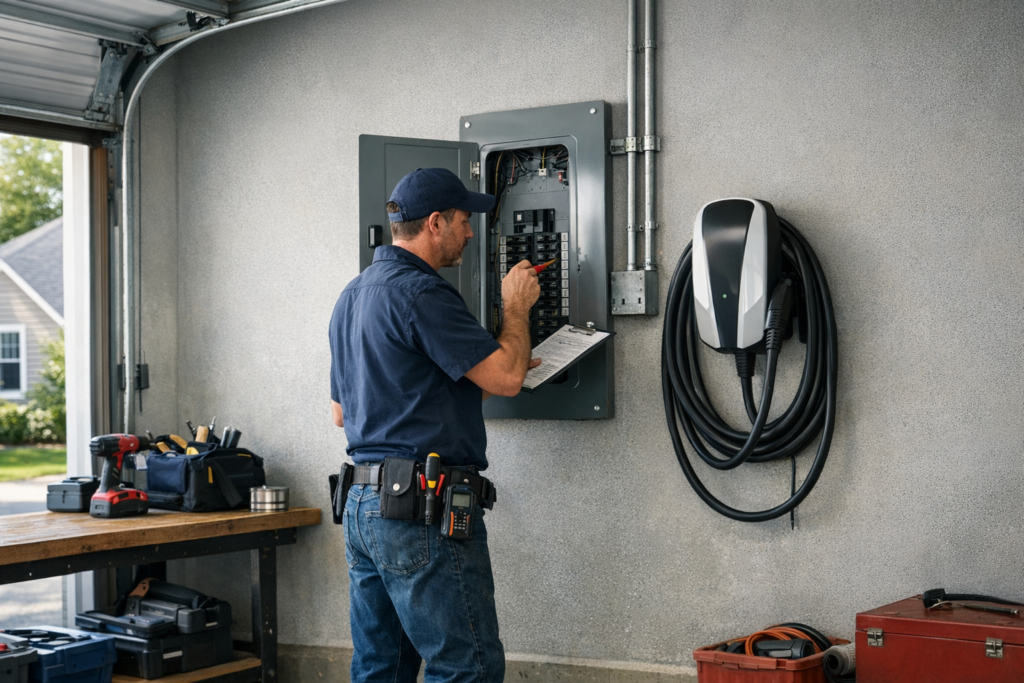
Most homes can support some type of electric vehicle charging, but not every electrical system can safely handle a dedicated Level 2 charger without an evaluation. The key question is whether your existing service, panel capacity, available breaker space, wiring method, and overall electrical load can support the added demand. A qualified electrician can determine whether your electrical panel for EV charger installation is ready as-is, needs modifications, or should be upgraded before the charger is installed.
Why EV Chargers Put New Demands on Your Electrical System
Electric vehicle charging is different from plugging in a typical appliance. A Level 2 EV charger can draw power for several continuous hours, often overnight. That steady demand matters because electrical systems are designed around both the size of individual circuits and the total load the building may place on the service at one time.
For homeowners and property owners throughout New Hampshire, Massachusetts, Maine, and Vermont, EV charger planning is especially important because many buildings have a mix of older wiring, upgraded appliances, electric heating equipment, standby generators, hot tubs, workshops, additions, or finished garages. Even if a panel looks modern on the outside, the actual capacity must be verified before adding another major electrical load.
An EV charger installation should never be based on guesswork. The panel may have an open breaker space, but that does not automatically mean the service has enough available capacity. The safest approach is to have a licensed electrician review the entire electrical system before selecting the charger size.
Level 1 vs. Level 2 Charging: What Your Panel Needs to Support
EV charging is commonly divided into Level 1 and Level 2 charging. Understanding the difference helps explain why panel capacity matters.
Level 1 Charging
Level 1 charging typically uses a standard 120-volt receptacle. It is the slowest charging option and may be suitable for drivers with short daily commutes, plug-in hybrid vehicles, or situations where charging speed is not a major concern. However, even Level 1 charging should be connected to a properly wired, grounded, and safe circuit. Using extension cords or worn receptacles is not a safe long-term charging solution.
Level 2 Charging
Level 2 charging uses a 240-volt circuit and charges much faster. This is the option most homeowners consider when they want dependable overnight charging. Depending on the charger and vehicle, a Level 2 charger may require a 30-amp, 40-amp, 50-amp, or larger circuit. Some chargers are hardwired, while others use a dedicated receptacle, depending on the equipment and installation requirements.
Because Level 2 chargers can represent a significant continuous electrical load, an electrician must confirm that the electrical panel for EV charger use can safely support the added demand.
Signs Your Panel May Be Ready for an EV Charger
Your electrical system may be a good candidate for a Level 2 EV charger if it has adequate service capacity, room for a properly sized breaker, and no existing safety or condition issues. A professional evaluation is still necessary, but these signs are generally encouraging:
- The home has a modern electrical panel in good condition.
- The service size is adequate for the home’s current loads and the proposed charger.
- There is physical breaker space available in the panel.
- The panel is not overloaded with tandem or double-tapped breakers.
- The garage or parking area can be reached with a practical wiring route.
- Existing wiring, grounding, and bonding appear up to current safety expectations.
- Major electrical loads such as heating, air conditioning, water heating, ranges, dryers, and generators have been properly accounted for.
These are helpful indicators, not final approval. The determining factor is a proper electrical load calculation and field inspection by a qualified electrician.
Signs You May Need an Electrical Panel Upgrade First
An electrical panel upgrade may be needed if the existing system cannot safely support the additional EV charging load. In many older New England homes, the panel was not originally designed for today’s combination of central air conditioning, electric appliances, home offices, heat pumps, generators, and EV charging.
Common signs that your panel may need attention before EV charger installation include:
- Frequent breaker trips or flickering lights when large appliances start.
- An older 60-amp or 100-amp service with multiple modern electrical loads.
- No available breaker spaces in the main panel.
- Evidence of overheating, corrosion, moisture, or damaged conductors.
- Improper breaker types, double-tapped connections, or overcrowded wiring.
- Outdated equipment that can no longer be safely expanded.
- A desire to add multiple future electrical loads, such as heat pumps, a workshop, or a second EV charger.
Warning: Burning smells, buzzing sounds, warm panel covers, visible arcing, or repeated breaker tripping should be treated as safety concerns. Do not attempt to install or modify EV charging equipment until the electrical system has been inspected by a licensed electrician.
What an Electrician Checks Before Installing an EV Charger
A proper EV charger evaluation goes far beyond looking for an empty slot in the electrical panel. The electrician needs to understand how the building uses power, what equipment is already installed, and how the new charger will affect the system.
Service Size and Available Capacity
The electrician will identify the size of the electrical service and evaluate whether it can support the proposed charger. A 200-amp service may have enough capacity in many homes, but that is not automatic. A 100-amp service may still support charging in some situations, but it depends heavily on the home’s existing loads and the charger amperage.
Load Calculation
A load calculation estimates the electrical demand of the building based on connected equipment, square footage, appliances, heating and cooling systems, and other relevant loads. This helps determine whether the electrical panel for EV charger installation has enough remaining capacity.
This step is important because two homes with the same panel size may have very different electrical usage. A home with gas heat, gas cooking, and minimal electric appliances may have more available capacity than a similar home with electric heat, electric water heating, central air, and a hot tub.
Panel Condition
The electrician will inspect the panel for overheating, corrosion, damaged wiring, improper breaker installation, missing covers, poor labeling, and other safety concerns. If the panel is in poor condition, adding a high-demand EV charging circuit can make an existing problem worse.
Breaker Space
The panel must have room for the new circuit breaker or be configured in a safe, code-compliant way. Open space does not guarantee capacity, and lack of space does not always mean a full service upgrade is required. In some cases, a subpanel or panel replacement may be appropriate, depending on the existing system.
Wiring Route to the Charger
The distance from the electrical panel to the garage, driveway, parking structure, or commercial charging location affects installation complexity. Longer runs, finished walls, detached garages, underground wiring, and exterior mounting locations all require careful planning.
Grounding, Bonding, and Safety Protection
Grounding and bonding are essential to electrical safety. The electrician will confirm that the existing system is properly grounded and that the EV charger circuit includes the required protections for the equipment and installation environment.
Panel Upgrade, Subpanel, or Load Management?
If your current panel cannot easily support a Level 2 charger, that does not always mean there is only one solution. A licensed electrician can explain which option makes the most sense for the building, the vehicle, and your long-term electrical plans.
Electrical Panel Upgrade
A panel upgrade may be recommended when the existing equipment is outdated, full, damaged, undersized, or unable to support present and future loads. This can improve capacity, safety, organization, and long-term reliability. For homeowners planning additional electrical improvements, upgrading the panel can be a smart investment.
Electrical Service Upgrade
A service upgrade involves increasing the capacity of the electrical service feeding the property. This is more involved than replacing a panel and may require coordination with the utility and local inspection process. Service upgrades are commonly considered when a property is transitioning to heavier electrical use, such as EV charging, heat pumps, electric water heating, or expanded commercial equipment.
Subpanel Installation
A subpanel can provide additional breaker space in another area of the building, such as a garage or workshop. However, a subpanel does not create additional service capacity by itself. The main service must still be able to support the connected load.
Load Management
Load management equipment can sometimes allow EV charging without a full service upgrade by limiting or controlling charging when other major loads are operating. This can be useful in certain homes where the service has limited spare capacity. The equipment must be properly selected and installed by a qualified electrician.
How Charger Size Affects Your Electrical Panel
Many EV owners assume a larger charger is always better. In reality, the best charger size is the one that matches your driving habits, vehicle capability, existing electrical system, and future needs.
A higher-amperage charger can add range faster, but it also places a larger demand on the electrical system. If you typically park overnight and drive a moderate distance each day, a smaller Level 2 charger may provide more than enough charging without requiring a major upgrade. If you have multiple EVs, long daily driving needs, or commercial fleet vehicles, a larger system may be more appropriate.
An experienced electrician can help you compare charging performance with panel capacity so you do not overspend on unnecessary electrical upgrades or undersize a system that will become inconvenient later.
Residential EV Charger Considerations in New England Homes
Homes throughout New Hampshire, Massachusetts, Maine, and Vermont vary widely in age and electrical condition. Historic homes, older farmhouses, seasonal properties, and homes with additions often have electrical systems that were expanded over time. That can make EV charger planning more complex.
Common New England considerations include:
- Older panels that were installed before modern electrical demand increased.
- Detached garages that require careful wiring routes.
- Cold-weather charging demands during long winters.
- Generator systems that need proper coordination with household loads.
- Basements, crawl spaces, and finished garages that affect wiring access.
- Snow, ice, and exterior exposure for outdoor charging locations.
Cold weather can reduce EV efficiency and increase the importance of reliable home charging. A properly installed charger should be placed where it is accessible, protected as appropriate, and installed with materials suitable for the environment.
Commercial EV Charger Planning
Businesses, property managers, developers, and facility managers have additional considerations when planning EV charging. A commercial property may need to support employee charging, tenant charging, customer charging, fleet vehicles, or future expansion.
For commercial EV charger installations, the electrical evaluation may include:
- Existing service capacity and distribution equipment.
- Panelboard and switchgear condition.
- Quantity and placement of charging stations.
- Parking layout and conduit routing.
- Pedestal-mounted versus wall-mounted chargers.
- Potential future expansion for additional chargers.
- Load management or networked charging options.
- Effects on peak demand and overall facility load.
Commercial EV charging works best when planned as part of the property’s broader electrical infrastructure rather than treated as a simple add-on. Early planning can prevent avoidable rework, reduce disruption, and improve long-term flexibility.
Common Mistakes to Avoid
EV charger installation is not the place to cut corners. The charger may seem like a simple appliance, but it is connected to a powerful circuit that operates for long periods. Avoid these common mistakes:
- Assuming an open breaker space means the panel can handle the charger.
- Choosing the largest charger without evaluating actual charging needs.
- Using an existing dryer or welder circuit without professional review.
- Installing charging equipment on an old or damaged panel.
- Running undersized wiring or using materials not suited for the environment.
- Ignoring future plans for additional EVs, heat pumps, or generators.
- Relying on extension cords, adapters, or temporary wiring methods.
EV charger circuits should be installed by a qualified licensed electrician. Improper installation can create overheating, shock, fire, and equipment damage hazards.
Cost Factors That Influence EV Charger Electrical Work
The cost of preparing an electrical panel for EV charger installation depends on the condition of the existing system and the scope of work required. A straightforward installation near a modern panel is very different from a project that requires a panel upgrade, long conduit run, detached garage wiring, or service upgrade.
Common cost factors include:
- The amperage and type of EV charger.
- Distance from the panel to the charging location.
- Whether the charger is hardwired or receptacle-based.
- Panel condition and available breaker space.
- Need for a panel upgrade, subpanel, or service upgrade.
- Indoor versus outdoor installation requirements.
- Finished walls, trenching, conduit, or structural access challenges.
- Inspection and permitting requirements that apply to the project location.
The best way to control cost is to start with a professional assessment before purchasing equipment. That ensures the charger you select is compatible with your electrical system and your practical charging needs.
Questions to Ask Before Installing an EV Charger
Before scheduling installation, it helps to gather basic information about your vehicle, panel, and parking setup. Ask these questions:
- How many miles do I typically drive each day?
- Do I need fast overnight charging, or will a smaller Level 2 charger be enough?
- Where will the vehicle park most of the time?
- Is the charger location indoors, outdoors, attached, or detached from the home?
- Do I plan to add a second EV in the future?
- Do I have electric heat, heat pumps, a hot tub, generator, or other large loads?
- Has the electrical panel been upgraded or inspected recently?
- Will this installation support residential use, commercial use, tenants, customers, or a fleet?
These details help your electrician recommend a safe and practical installation plan.
So, Can Your Electrical System Handle an EV Charger?
Your electrical system can handle an EV charger if the service has enough available capacity, the panel is in safe condition, the circuit can be properly installed, and the charging equipment is matched to the building’s electrical load. If any of those factors fall short, the solution may be a panel upgrade, service upgrade, subpanel, load management system, or different charger size.
The most reliable answer comes from an on-site electrical evaluation. Electrical Constructors LLC provides residential, commercial, industrial, and new construction electrical services throughout New Hampshire, Massachusetts, Maine, and Vermont, including EV charger installation, electrical panel upgrades, service upgrades, troubleshooting, inspections, and complete electrical system improvements.
If you are planning home or commercial EV charging, have your electrical panel evaluated before installation. The right planning can improve safety, protect your equipment, reduce future headaches, and make daily charging far more convenient.