
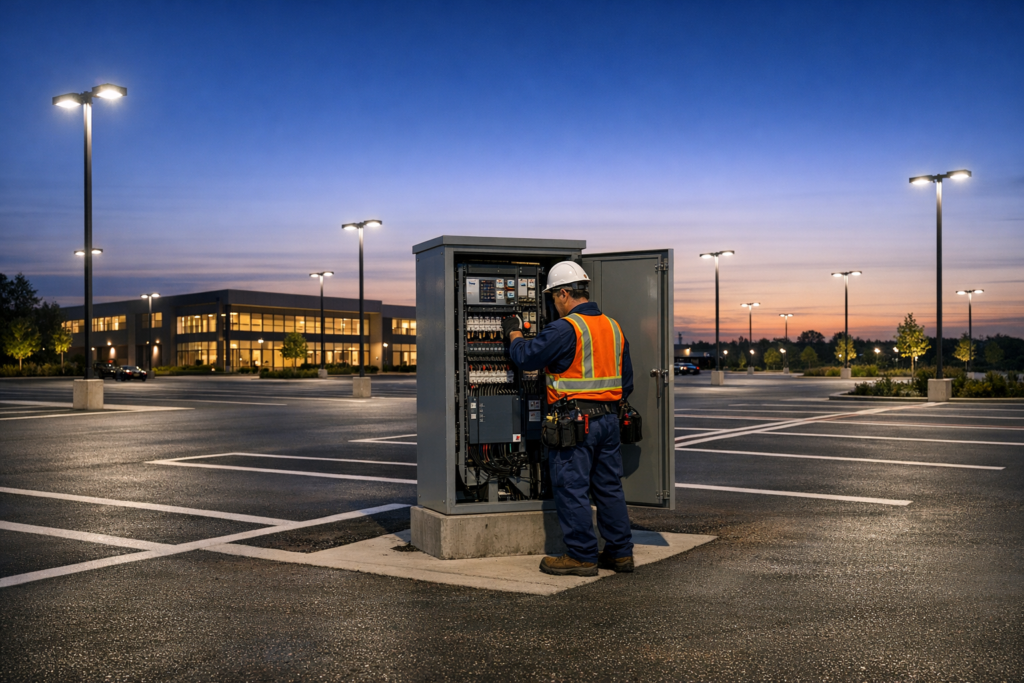
Effective parking lot lighting does more than brighten pavement after dark. It helps drivers see pedestrians, supports security cameras, reduces trip-and-fall risks, guides visitors to entrances, and gives employees, tenants, customers, and residents greater confidence when arriving or leaving at night.
For commercial properties, multifamily buildings, retail centers, offices, industrial sites, and managed facilities throughout New Hampshire, Massachusetts, Maine, and Vermont, exterior lighting is also a long-term reliability issue. New England weather, aging electrical infrastructure, winter darkness, snow accumulation, and repeated freeze-thaw cycles can all affect how well an outdoor lighting system performs.
Why Parking Area Lighting Matters
Parking areas are transition spaces. People are walking between vehicles and buildings, drivers are backing out, delivery vehicles are moving through, and visibility can change quickly during rain, fog, snow, or early evening hours. Poor lighting makes all of that more difficult.
A well-designed parking lot lighting system improves visibility across vehicle lanes, pedestrian routes, building entrances, accessible parking spaces, loading areas, dumpsters, payment kiosks, and other high-use zones. The goal is not simply to make the property look bright. The goal is to provide useful, even illumination where people actually need it.
When lighting is properly designed and installed, property owners often gain several benefits:
- Improved visibility for pedestrians and drivers
- Better support for security cameras and surveillance systems
- Reduced dark spots near entrances, corners, and walkways
- Greater confidence for employees, customers, tenants, and visitors
- Improved curb appeal and nighttime appearance
- Lower maintenance needs when older fixtures are upgraded to quality LED lighting
- More efficient use of electricity through modern controls and fixture selection
Common Problems With Older Parking Lot Lighting
Many parking lots in New England rely on aging pole lights, wall packs, underground wiring, or control systems that were installed years ago. Even when the lights still turn on, they may no longer provide the visibility, efficiency, or reliability the property needs.
Uneven Illumination
One of the most common issues is uneven lighting. Some areas may be overly bright while others remain dark. This often happens when fixtures are spaced poorly, aimed incorrectly, mounted at the wrong height, or using outdated lamp technology.
Uneven lighting can create glare, deep shadows, and high-contrast areas that make it harder for people to see clearly. In a parking lot, consistency is often just as important as brightness.
Burned Out or Flickering Fixtures
Burned out lights are easy to overlook until multiple fixtures fail. Flickering fixtures, lights that cycle on and off, or lamps that take a long time to reach full brightness can point to failing lamps, ballasts, drivers, photocells, wiring connections, or fixture components.
Because pole lights and exterior fixtures are exposed to weather, moisture intrusion and corrosion can also contribute to failures. A licensed electrician can identify whether the issue is a simple component failure or part of a larger electrical problem.
Glare and Light Trespass
More light is not always better. Poorly aimed fixtures can shine into drivers eyes, neighboring properties, upper-level windows, or roadway areas. Excessive glare may reduce visibility rather than improve it.
Modern exterior lighting design focuses on controlled light distribution. Properly selected fixtures direct light downward and across the intended area instead of wasting light into the sky or onto nearby properties.
Outdated High-Intensity Discharge Lighting
Older metal halide, high-pressure sodium, or similar fixtures may use more energy, require more maintenance, and provide lower-quality visibility than modern LED systems. Some older lamps also shift color or lose light output over time, even before they fail completely.
Upgrading to LED parking area lighting can improve clarity, reduce maintenance frequency, and provide more consistent illumination when the system is properly designed.
What Makes a Parking Lot Lighting System Effective?
Good parking lot lighting starts with design. The best results come from evaluating the property layout, existing electrical infrastructure, fixture locations, mounting heights, pedestrian paths, vehicle circulation, and how the space is used after dark.
Appropriate Light Levels
Different areas of a property may need different lighting levels. A main entrance, pedestrian walkway, loading dock, fuel area, or payment station may require more targeted illumination than a low-traffic overflow parking section.
The objective is balanced visibility. A qualified electrical contractor can help determine practical fixture placement and output based on the use of the property, not guesswork.
Uniform Coverage
Uniform coverage helps people move safely because their eyes do not have to constantly adjust between bright and dark areas. This is especially important during winter months, when snow and ice can hide curbs, wheel stops, potholes, uneven pavement, and walkway edges.
For properties in New Hampshire, Massachusetts, Maine, and Vermont, winter performance should be part of the conversation. Shorter daylight hours, storm cleanup, and snowbanks can all change how light reaches the pavement.
Proper Fixture Placement
Fixture placement affects everything from visibility to energy use. Pole-mounted lights can cover larger parking areas, while wall-mounted fixtures can help illuminate building perimeters, service doors, loading areas, and pedestrian zones.
Placement should account for traffic flow, landscaping, snow storage areas, building entrances, accessibility routes, and areas where vehicles or pedestrians may be difficult to see.
Quality LED Fixtures
LED technology is now the preferred choice for many parking area lighting upgrades because it can provide strong visibility with lower energy use and less frequent maintenance than many older lighting systems. However, fixture quality matters.
A good LED fixture should be selected for the application. Important considerations include light distribution pattern, color temperature, lumen output, fixture durability, weather rating, mounting type, serviceability, and compatibility with controls.
Reliable Controls
Lighting controls help the system operate when needed and reduce unnecessary energy use. Depending on the property, controls may include photocells, time clocks, motion-based dimming, contactors, lighting control panels, or building automation integration.
Controls should be designed for reliability. A poorly installed or misconfigured control system can cause lights to stay on during the day, fail to operate at night, or operate inconsistently across the property.
LED Upgrades for Better Visibility and Lower Maintenance
Many property owners explore LED upgrades because their existing exterior lighting is expensive to maintain or no longer performs well. A thoughtful LED retrofit or complete fixture replacement can make a noticeable difference.
LED upgrades may help improve:
- Nighttime visibility and color clarity
- Energy efficiency compared with many older fixtures
- Maintenance intervals by reducing lamp and ballast replacements
- Cold-weather reliability when appropriate fixtures are selected
- Light control through better optics and fixture design
- Compatibility with modern lighting controls
Not every retrofit approach is equal. In some cases, replacing the entire fixture is the better long-term solution. In other cases, a retrofit kit may be appropriate if the existing housing, wiring, mounting, and condition support it. An electrician should evaluate the system before recommending an approach.
Safety Considerations Property Owners Should Not Overlook
Exterior lighting involves more than installing brighter fixtures. These systems are exposed to moisture, temperature swings, vehicle impact risks, corrosion, and long electrical runs. Safe installation and maintenance require qualified electrical knowledge.
Important safety considerations include:
- Condition of underground wiring and conduit
- Proper grounding and bonding
- Weatherproof connections and enclosures
- Fixture mounting security
- Condition of poles, bases, and handholes
- Load capacity of existing circuits and panels
- Protection from physical damage
- Safe access for future maintenance
Parking lot lighting should be installed, repaired, and serviced by licensed electricians. Pole lights, exterior circuits, and control equipment can involve hazardous voltage, aerial work, underground wiring, and code-sensitive installation details.
Signs Your Property May Need a Lighting Assessment
A professional lighting assessment can help determine whether your property needs repairs, fixture replacement, control upgrades, or a more complete redesign. It is especially valuable when lighting problems have developed gradually over time.
Consider scheduling an evaluation if you notice:
- Dark areas near entrances, walkways, or parking spaces
- Frequent lamp, ballast, or driver failures
- Lights that flicker, buzz, cycle, or turn on inconsistently
- Complaints from tenants, employees, customers, or visitors
- Security cameras that struggle to capture clear nighttime footage
- Fixtures that are visibly damaged, corroded, or filled with moisture
- Pole lights that no longer match the layout of the property
- Exterior lights staying on during the day or off at night
- High electrical costs from outdated lighting equipment
For property managers and facility teams, an assessment can also help prioritize repairs and plan capital improvements before failures become urgent.
Parking Lot Lighting for Commercial and Multifamily Properties
Different properties have different lighting needs. A retail parking lot may require strong visibility near storefronts and cart return areas. An office property may focus on employee arrival and departure times. A multifamily property may need consistent lighting along pedestrian routes, garages, dumpsters, and visitor parking. Industrial and warehouse sites may need durable lighting near loading docks, truck circulation routes, and service areas.
The right solution depends on how the property is used. Electrical Constructors LLC works with homeowners, business owners, contractors, developers, and property managers throughout New Hampshire, Massachusetts, Maine, and Vermont to support safe, reliable, and practical electrical systems for residential, commercial, industrial, and new construction environments.
Electrical Infrastructure Behind the Lighting
Fixtures are only one part of the system. The electrical infrastructure behind parking lot lighting is just as important for long-term performance.
A complete evaluation may include the electrical panel, breakers, contactors, photocells, time clocks, conduits, junction boxes, wiring, pole bases, grounding, and control equipment. If the existing system is old or has been modified multiple times, troubleshooting may be needed before upgrades are made.
Common infrastructure concerns include overloaded circuits, failed photocells, deteriorated underground wiring, water-damaged junction boxes, corroded connections, and outdated controls. Addressing these issues helps prevent repeat service calls and protects the investment in new fixtures.
Planning a Lighting Upgrade
A successful parking lot lighting project should begin with a review of the property and the goals for the upgrade. Some owners want to reduce maintenance. Others want to improve safety, support surveillance, address tenant concerns, or prepare a property for evening operations.
A practical planning process may include:
- Reviewing the existing lighting layout and electrical infrastructure
- Identifying dark spots, glare issues, and high-priority safety areas
- Evaluating fixture condition, pole locations, and control equipment
- Discussing LED options, mounting methods, and lighting controls
- Considering future maintenance access and long-term reliability
- Coordinating installation with business hours, tenant access, or site operations
- Testing the completed system after dark to confirm performance
This approach helps avoid the common mistake of replacing fixtures without solving the underlying design or electrical issue.
Cost Factors for Parking Area Lighting Projects
The cost of a parking lot lighting project can vary widely because every site is different. A simple fixture replacement is very different from a full redesign with new poles, trenching, underground conduit, controls, or service upgrades.
Key factors that influence cost include:
- Number and type of fixtures
- Mounting height and equipment access requirements
- Condition of existing wiring, poles, and controls
- Whether trenching or underground conduit work is needed
- Fixture quality, output, and distribution pattern
- Control system complexity
- Repair needs discovered during troubleshooting
- Scheduling requirements for active commercial properties
Property owners should be cautious about choosing the lowest-cost fixture without reviewing durability, photometric performance, warranty support, and installation quality. Exterior lighting is a long-term system, and poor fixture selection can lead to early failures, glare, inadequate coverage, or higher maintenance costs.
Preventative Maintenance Helps Protect Your Investment
Even high-quality lighting systems benefit from routine maintenance. Preventative maintenance helps identify small issues before they become larger outages or safety concerns.
Recommended maintenance items may include:
- Checking for burned out, dim, or flickering fixtures
- Inspecting lenses for dirt, damage, or discoloration
- Looking for water intrusion or corrosion
- Testing photocells, time clocks, and controls
- Inspecting accessible wiring, enclosures, and connections
- Verifying that fixtures are properly aimed
- Reviewing pole condition and visible base hardware
- Confirming lighting performance after property layout changes
In New England, it is often wise to inspect exterior lighting before winter, when shorter days and severe weather increase the importance of dependable nighttime visibility.
Common Mistakes to Avoid
Parking lot lighting problems often happen when projects are approached as simple fixture swaps instead of complete electrical and visibility improvements.
Common mistakes include:
- Choosing fixtures based only on wattage rather than usable light distribution
- Installing lights that create glare for drivers or neighboring properties
- Ignoring the condition of wiring, poles, and controls
- Using fixture color temperatures that are too harsh for the setting
- Failing to account for pedestrian paths and building entrances
- Overlooking snowbanks, landscaping, signs, or obstructions
- Neglecting future maintenance access
- Assuming brighter always means safer
An experienced electrical contractor can help avoid these issues by looking at the system as a whole.
When to Call a Licensed Electrical Contractor
You should call a licensed electrical contractor when parking lot lights are failing, visibility is poor, controls are unreliable, fixtures are damaged, or you are planning an LED upgrade. You should also request professional help before adding fixtures to an existing circuit or modifying any outdoor electrical equipment.
Electrical Constructors LLC provides residential, commercial, industrial, and new construction electrical services, including troubleshooting, lighting installation, electrical repairs, service upgrades, electrical inspections, preventative maintenance, generator installation, EV charger installation, surge protection, code corrections, and complete electrical system installations.
For property owners, managers, contractors, and developers throughout New Hampshire, Massachusetts, Maine, and Vermont, dependable exterior lighting is an important part of operating a safer, more functional property after dark. A properly designed and professionally installed parking lot lighting system can improve visibility, reduce maintenance concerns, and support long-term electrical reliability.