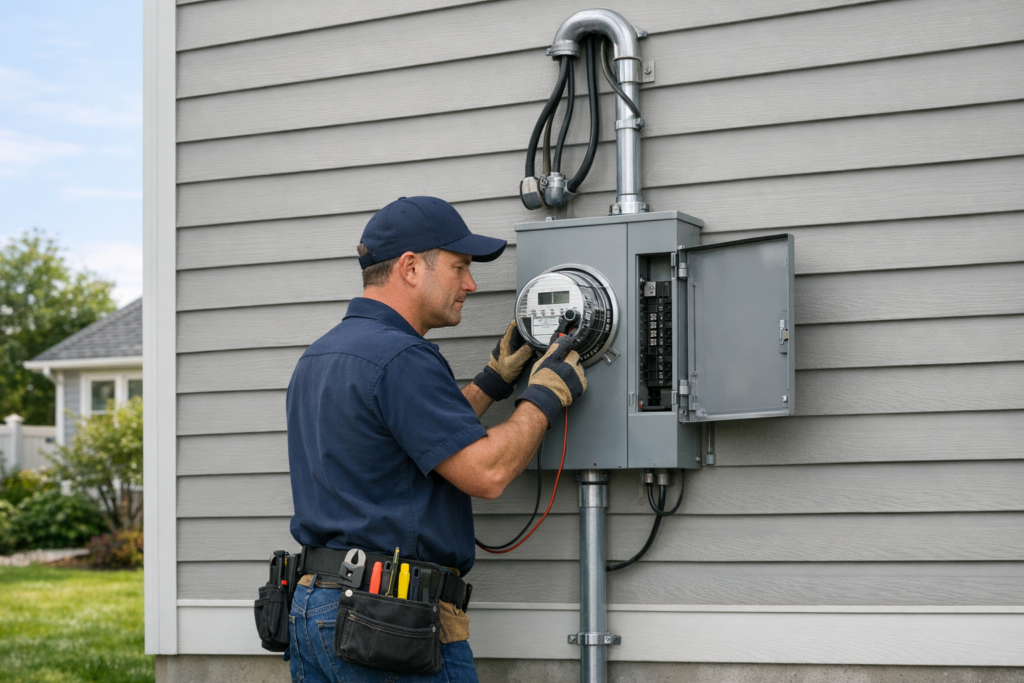
An electrical service upgrade is necessary when your existing service entrance can no longer safely or reliably support the amount of power your home or business needs. Common reasons include an undersized service, an outdated electrical panel, frequent breaker trips, corrosion at the meter or service equipment, planned additions, new high-demand equipment, generator installation, EV charger installation, or code-related concerns discovered during an inspection.
For many properties throughout New Hampshire, Massachusetts, Maine, and Vermont, the service entrance is one of the most important parts of the electrical system and one of the most commonly overlooked. It is the point where utility power enters the building, passes through the meter, and feeds the main electrical panel or service equipment. When that equipment is old, damaged, overloaded, or no longer suited to modern electrical use, upgrading it can improve safety, capacity, reliability, and long-term property value.
What Is an Electrical Service Upgrade?
An electrical service upgrade increases or modernizes the capacity and condition of the main electrical equipment that brings power into a property. In many residential settings, this may involve upgrading from an older 60 amp or 100 amp service to a larger service such as 200 amps, depending on the property’s electrical load and utility requirements. In commercial or mixed-use buildings, the upgrade may involve larger service equipment, additional distribution capacity, or redesigned electrical infrastructure to support business operations.
A service upgrade may include some or all of the following components:
- New meter socket or meter enclosure
- Updated service entrance cable or conduit
- New main electrical panel or service disconnect
- Updated grounding and bonding system
- Replacement of deteriorated exterior service equipment
- Coordination with the electric utility
- Electrical inspection and approval where required
- Load calculations to determine the proper service size
It is important to understand that an electrical service upgrade is not always the same as a simple panel replacement. A panel replacement changes the distribution panel, while a service upgrade may involve the entire service entrance from the utility connection through the metering equipment and main disconnecting means.
Why Service Entrance Capacity Matters
Your electrical service determines how much power your property can safely receive and distribute. Older homes were often designed before modern electrical demands became common. Central air conditioning, electric ranges, heat pumps, hot tubs, standby generators, EV chargers, finished basements, home offices, workshops, and large appliances can place demands on a system that was originally designed for a much simpler lifestyle.
Commercial properties face similar challenges. Restaurants, offices, retail spaces, warehouses, medical offices, multi-tenant buildings, and light industrial spaces may add equipment over time without fully evaluating whether the original electrical service can support the increased demand. When the service entrance is undersized or deteriorated, the result can be nuisance outages, overheated equipment, limited expansion options, and avoidable downtime.
A properly planned electrical service upgrade gives the property enough capacity for present needs while allowing room for reasonable future growth.
Signs You May Need an Electrical Service Upgrade
Not every electrical issue means you need a larger service, but certain warning signs should be taken seriously. If you notice any of the following conditions, it is time to schedule an evaluation by a qualified electrician.
Frequent Breaker Trips or Blown Fuses
Breakers are designed to protect wiring from overloads and faults. If breakers trip frequently, especially when multiple appliances or pieces of equipment are running, the system may be overloaded or there may be a circuit-specific problem that needs troubleshooting. Older fuse panels can also indicate that the service equipment is outdated and may not be appropriate for modern electrical loads.
Lights Flicker or Dim When Equipment Starts
Brief light dimming may occur when certain large motors start, but repeated or severe flickering can point to loose connections, overloaded circuits, voltage drop, service equipment issues, or utility-related concerns. This is especially important when flickering affects multiple rooms or large areas of a commercial building.
You Still Have a 60 Amp or Undersized Service
Many older homes in New England still have smaller electrical services that were adequate decades ago but are limited by today’s standards. If your property has limited panel space, old service entrance conductors, or a small main service rating, an electrical service upgrade may be a practical step before adding major electrical loads.
The Panel Is Full or Uses Tandem Breakers Improperly
A full panel does not automatically mean the service must be upgraded, but it does indicate that your system needs professional review. Adding circuits without available capacity can create unsafe conditions. A licensed electrician can determine whether a subpanel, panel replacement, load management, or full service upgrade is the right solution.
Exterior Service Equipment Is Rusted, Damaged, or Deteriorated
New England weather is hard on exterior electrical equipment. Snow, ice, freeze-thaw cycles, coastal moisture in some areas, and years of exposure can damage meter sockets, conduit, service entrance cable, fittings, and grounding components. Corrosion, cracked insulation, loose equipment, water intrusion, or visible damage should never be ignored.
You Are Adding High-Demand Electrical Equipment
Additional load is one of the most common reasons for a service upgrade. Examples include EV chargers, electric heat pumps, central air conditioning, electric water heaters, electric ranges, welders, commercial kitchen equipment, workshop equipment, medical office equipment, or larger HVAC systems. Before installing this equipment, the electrical service should be evaluated to confirm adequate capacity.
You Are Planning a Renovation, Addition, or New Use for the Property
Renovations often reveal limitations in older electrical systems. A kitchen remodel, finished basement, addition, tenant fit-out, office build-out, or conversion of space may trigger the need for added circuits, improved grounding, updated panels, or more service capacity. Addressing service limitations early helps prevent redesigns, schedule delays, and costly rework.
Safety Concerns That Should Not Be Ignored
Electrical service equipment should never be opened, repaired, or modified by an unqualified person. Service entrance components can contain dangerous levels of current, and some portions may remain energized even when the main breaker is off. Work at this level requires proper training, tools, utility coordination, and knowledge of applicable electrical codes.
Call a licensed electrician promptly if you notice:
- Burning odors near the panel or meter
- Buzzing, crackling, or sizzling sounds from electrical equipment
- Warm or discolored breakers, outlets, or panel covers
- Visible arcing or scorch marks
- Water near electrical service equipment
- A damaged meter socket or mast after a storm
- Repeated loss of power affecting only your property
These symptoms may indicate a serious hazard. In some cases, the appropriate response may involve shutting down affected equipment and contacting the utility or emergency services, depending on the severity and immediate risk.
Electrical Service Upgrade Versus Panel Upgrade
Property owners often use the terms service upgrade and panel upgrade interchangeably, but they are not identical. A panel upgrade typically replaces the electrical distribution panel where breakers are located. An electrical service upgrade may include the panel and also upgrades the service entrance equipment that supplies it.
A panel upgrade may be sufficient when the service size is adequate but the panel is outdated, damaged, crowded, or no longer compatible with the property’s needs. A full service upgrade may be needed when the service capacity itself is too small or when the meter socket, service conductors, grounding system, or utility connection must be replaced or modernized.
The right answer depends on a professional load calculation, the condition of existing equipment, present and future electrical needs, and utility requirements.
Common Reasons Homeowners Upgrade Electrical Service
Residential electrical systems in New Hampshire, Massachusetts, Maine, and Vermont often face a combination of aging infrastructure and increasing demand. Many homes were built before today’s appliances, electronics, and electrification trends became common.
Homeowners commonly request service upgrades for:
- Installing a Level 2 EV charger
- Adding central air conditioning or heat pumps
- Preparing for a standby generator
- Renovating kitchens, bathrooms, basements, or additions
- Replacing outdated fuse boxes or obsolete panels
- Adding electric ranges, dryers, water heaters, or hot tubs
- Improving capacity for home offices and workshops
- Correcting safety issues found during a home inspection
A service upgrade can also make future projects easier. Instead of adding circuits one at a time to an already strained system, the electrical infrastructure can be planned with a more complete view of the home’s long-term needs.
Common Reasons Businesses Upgrade Electrical Service
Commercial electrical systems must support productivity, safety, equipment reliability, and occupant comfort. When the available service is too limited, a business may struggle to expand operations or add essential equipment.
Business owners and property managers may need an electrical service upgrade when:
- A tenant fit-out requires additional electrical capacity
- New HVAC, refrigeration, manufacturing, or kitchen equipment is being installed
- Existing panels are overloaded or lack breaker space
- Lighting, controls, or automation systems are being modernized
- EV charging stations are planned for customers, tenants, or fleet vehicles
- Critical equipment requires more reliable power distribution
- The building is being renovated, expanded, or repurposed
- Preventative maintenance identifies deteriorated service equipment
For commercial properties, planning is especially important because service upgrades may require coordination among electricians, utility representatives, property owners, tenants, engineers, and local inspectors. Starting early helps reduce downtime and avoid project delays.
What Happens During a Service Entrance Upgrade?
A well-executed electrical service upgrade starts with evaluation and planning. The electrician reviews the existing service size, panel condition, grounding and bonding, visible service entrance equipment, electrical loads, and the owner’s future plans. For commercial projects or complex residential systems, additional design work may be required.
Although every property is different, the process commonly includes:
- Evaluating current electrical equipment and service capacity
- Discussing planned additions, appliances, equipment, generators, or EV chargers
- Performing a load calculation to determine appropriate service size
- Coordinating with the utility provider when the utility connection or meter equipment is involved
- Replacing or upgrading service entrance components
- Installing a new panel, main disconnect, meter socket, conduit, or grounding components as needed
- Labeling circuits and verifying safe operation
- Completing inspection requirements where applicable
Because service work often involves the utility connection, the power may need to be temporarily disconnected. A professional contractor will help plan the timeline so homeowners, tenants, and businesses understand what to expect.
Permits, Inspections, and Code Considerations
Electrical service work is not a casual repair. It typically involves utility coordination and must be completed according to applicable electrical codes and local requirements. Permit and inspection processes vary by jurisdiction, property type, and project scope, so they should be confirmed before work begins.
A qualified electrical contractor understands how to plan the work, communicate with the appropriate parties, and install equipment that meets current safety expectations. Property owners should avoid contractors who suggest bypassing required approvals or cutting corners on service entrance equipment.
Cost Factors That Affect an Electrical Service Upgrade
The cost of an electrical service upgrade depends on the size and complexity of the project. A straightforward residential upgrade is very different from a commercial service replacement, multi-meter installation, or property with difficult utility access.
Common cost factors include:
- Existing service size and desired new capacity
- Condition of the meter socket, panel, conduit, grounding, and service conductors
- Overhead versus underground utility service
- Distance between the utility connection, meter, and electrical panel
- Whether interior wiring corrections are needed
- Accessibility of equipment locations
- Generator, EV charger, or load management requirements
- Commercial occupancy needs and scheduling constraints
- Permit, inspection, and utility coordination requirements
The lowest price is not always the best value. Service entrance equipment is foundational to the safety and reliability of the entire electrical system. Proper sizing, quality materials, neat workmanship, and code-compliant installation matter.
Do You Always Need a Larger Service?
No. An electrical service upgrade should be based on actual load requirements and equipment condition, not guesswork. Sometimes the better solution is a dedicated circuit, panel replacement, subpanel, circuit redistribution, equipment repair, or load management strategy.
For example, a home adding an EV charger may or may not need a full service upgrade depending on existing loads, service size, charger rating, and whether load management equipment is appropriate. A business adding equipment may need additional circuits but not necessarily a larger utility service. A professional assessment helps avoid unnecessary expense while ensuring the system remains safe and dependable.
Why New England Properties Often Need Service Evaluation
Across New Hampshire, Massachusetts, Maine, and Vermont, many properties combine older construction with modern electrical expectations. Historic homes, older multifamily buildings, long-standing commercial properties, and rural properties may have electrical systems that were expanded over many years by different owners and contractors.
Severe winter weather also adds practical concerns. Ice, falling limbs, heavy snow, and wind can damage overhead service equipment. Power outages increase interest in standby generators. Heating upgrades and electrification can increase demand. These regional realities make periodic electrical inspections and service evaluations especially valuable.
Planning for Generators, EV Chargers, and Future Loads
If you are considering a standby generator, EV charger, heat pump system, addition, or major renovation, evaluate the electrical service before equipment is purchased. Planning early helps determine whether the service can support the new load, whether transfer equipment is needed, and whether the panel has enough capacity and physical space.
This is also the right time to think beyond the immediate project. If a homeowner plans to add an EV charger now and heat pumps later, or if a commercial property owner expects future tenant improvements, the service upgrade can be designed with those possibilities in mind. Thoughtful planning can reduce the need to redo electrical work later.
When to Schedule a Professional Evaluation
You should schedule a professional service evaluation if your electrical system is older, your panel is full, you are planning new equipment, or you have noticed signs of overload or deterioration. A licensed electrician can determine whether you need an electrical service upgrade, a panel replacement, circuit repairs, or another targeted solution.
Electrical Constructors LLC provides residential, commercial, industrial, and new construction electrical services throughout New Hampshire, Massachusetts, Maine, and Vermont. Whether you are upgrading an older home, preparing a business property for new equipment, planning generator readiness, or improving long-term electrical reliability, a professional assessment is the safest place to start.
Key Takeaway
An electrical service upgrade becomes necessary when the service entrance is unsafe, outdated, damaged, undersized, or unable to support current and future electrical needs. The best approach is not to guess based on panel appearance alone. Have the system evaluated by an experienced electrical contractor who can review capacity, condition, safety, utility coordination, and your long-term plans.
Upgrading the service entrance is a major improvement, but when it is done correctly, it gives your property a safer and more capable foundation for modern electrical use.