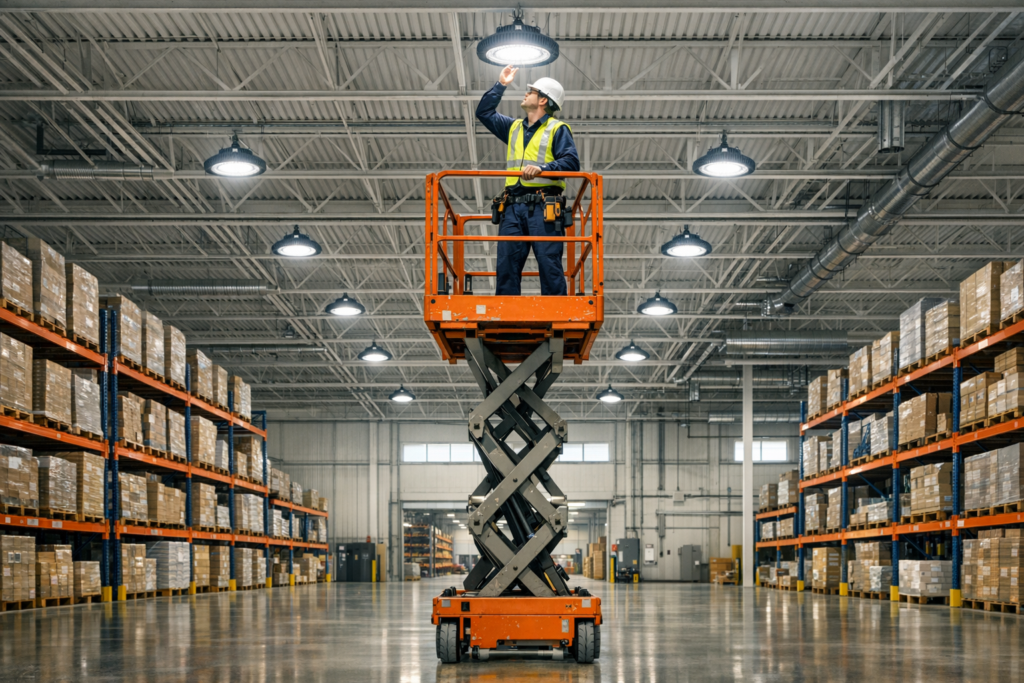
Warehouse LED lighting can improve productivity by giving employees brighter, more consistent visibility where work actually happens: aisles, loading areas, packing stations, equipment zones, inventory shelves, and exterior access points. The right lighting design helps reduce picking errors, improves safety, supports faster movement through the facility, and lowers ongoing energy and maintenance costs.
For warehouses, distribution centers, manufacturing spaces, and storage facilities throughout New Hampshire, Massachusetts, Maine, and Vermont, lighting is not just a utility expense. It is part of the operating environment. Poor lighting can slow teams down, increase eye strain, hide hazards, and make even a well-organized facility harder to manage.
How Better Warehouse Lighting Supports a More Productive Facility
Productivity in a warehouse depends on speed, accuracy, safety, and reliability. Lighting affects all four. When employees can clearly read labels, identify products, navigate aisles, operate equipment, and recognize hazards, their work becomes more efficient and less frustrating.
Well-designed warehouse LED lighting improves the workspace in several practical ways:
- It delivers more uniform illumination across aisles, racks, dock doors, workstations, and storage zones.
- It reduces shadows that can make labels, barcodes, tools, pallets, and floor markings harder to see.
- It provides reliable light output in facilities with long operating hours.
- It helps improve visibility for forklift operators, maintenance staff, pickers, packers, drivers, and supervisors.
- It can reduce the frequency of lamp replacements compared with older lighting technologies.
The goal is not simply to make the building brighter. The goal is to place the right amount and quality of light where people need it, without unnecessary glare, dark spots, or wasted energy.
Common Signs Your Current Warehouse Lighting Is Holding Operations Back
Many facilities continue operating with outdated lighting because the system still turns on. However, functioning lights are not always effective lights. Older fixtures may create inconsistent illumination, consume more energy than necessary, and require frequent maintenance.
Facility managers and business owners should consider a lighting evaluation if they notice any of the following issues:
- Dark aisles, shadowed rack faces, or poorly lit corners
- Employees using flashlights or phone lights to read labels or inspect products
- Uneven brightness between different areas of the warehouse
- Frequent bulb or ballast failures
- High electric bills caused by inefficient fixtures
- Glare from fixtures that makes it uncomfortable to look across the workspace
- Delayed starts or flickering from older lamps
- Lighting that does not match new rack layouts, workstations, or equipment areas
- Exterior loading, parking, or access areas that feel poorly illuminated after dark
These problems often become more noticeable during New England winters, when shorter daylight hours increase reliance on artificial lighting during normal operating shifts.
Why LED Fixtures Are Well Suited to Warehouse Environments
LED lighting has become a preferred choice for many commercial and industrial facilities because it offers strong performance, energy efficiency, and flexibility. A properly designed LED system can replace older metal halide, fluorescent, or high-pressure sodium fixtures while improving usable light throughout the building.
Improved Visibility and Uniformity
Warehouse work often requires employees to identify small details quickly. Labels, part numbers, barcodes, packing slips, shelving locations, safety markings, and equipment controls all depend on clear visibility. LED fixtures can be selected and positioned to provide better light distribution, helping eliminate the contrast between overly bright areas and dim zones.
Lower Energy Consumption
Lighting can represent a significant portion of a warehouse electrical load, especially in facilities that operate early mornings, evenings, overnight shifts, or extended seasonal hours. Modern LED fixtures typically use less electricity than many older lighting systems while delivering effective illumination. For large facilities, the energy savings can be meaningful over time.
Reduced Maintenance Demands
Replacing lamps in a warehouse is not always simple. It may require lifts, scheduling around operations, moving inventory, or shutting down specific areas. LED fixtures generally require less frequent lamp maintenance than many legacy systems, which can reduce disruption and help maintenance teams focus on higher-priority facility needs.
Better Compatibility with Controls
LED systems work well with occupancy sensors, daylight harvesting controls, dimming systems, timers, and zoning strategies. This allows the facility to reduce energy use in areas that are not constantly occupied while maintaining strong illumination where active work is taking place.
Lighting Design Details That Matter in a Warehouse
A successful warehouse lighting upgrade depends on much more than choosing a fixture from a catalog. Fixture type, mounting height, aisle layout, ceiling structure, rack configuration, workflow, and safety requirements all influence the final design.
Important design considerations include:
- Mounting height: High ceilings typically require fixtures designed to project light effectively to the floor and work surfaces.
- Beam distribution: Narrow aisles, open storage areas, loading docks, and production zones may require different light patterns.
- Fixture spacing: Improper spacing can create bright spots directly under fixtures and shadows between them.
- Glare control: Excessive glare can cause discomfort and reduce visibility, especially for forklift operators looking down long aisles.
- Color temperature: The appearance of the light should support alertness and visibility without feeling harsh or unnatural.
- Color rendering: Better color rendering can help employees distinguish product labels, wires, packaging, safety markings, and materials more accurately.
- Task lighting: Packing benches, service areas, inspection stations, and mechanical zones may need supplemental lighting.
- Emergency and egress lighting: Safety-related lighting must be evaluated as part of the overall system, not treated as an afterthought.
An experienced commercial electrician can assess existing conditions, understand how the facility is used, and recommend a system that supports the actual workflow rather than simply replacing old fixtures one-for-one.
High Bay, Low Bay, and Linear LED Fixture Options
Warehouses commonly use high bay or low bay lighting, depending on ceiling height and facility layout. High bay LED fixtures are often used in taller spaces with open floor areas, pallet racking, or industrial storage. Low bay fixtures are typically used in lower-ceiling spaces where light does not need to travel as far.
Linear LED fixtures may be well suited for long aisles, production lines, and areas where even, directional lighting is important. Round high bay fixtures can work well in open spaces, while aisle optics can help direct light down rack aisles instead of wasting output on the tops of shelves.
The best fixture choice depends on the building, not just the wattage. A lower-quality fixture placed incorrectly can still create poor visibility, even if it appears bright directly below the light. That is why layout and installation quality are just as important as fixture selection.
Lighting Controls Can Increase Efficiency Without Sacrificing Visibility
Many warehouses have areas that are not occupied constantly. Storage aisles, back rooms, staging zones, and break areas may only need full light output when employees are present. Lighting controls allow businesses to reduce energy use while keeping the facility ready for safe operation.
Common control strategies include:
- Occupancy sensors for intermittent-use areas
- Motion sensors for warehouse aisles and storage zones
- Daylight sensors where skylights or windows provide usable natural light
- Programmable schedules that match operating hours
- Separate lighting zones for offices, docks, production areas, and storage spaces
- Dimming controls where full brightness is not always required
Controls need to be designed carefully. If sensors turn lights off too quickly, fail to detect movement reliably, or create dark areas during active work, they can frustrate employees and reduce operational efficiency. A well-planned control system balances savings with safety and usability.
Safety Considerations for Warehouse Lighting Upgrades
Electrical safety should be central to any warehouse LED lighting project. Commercial and industrial facilities often include high ceilings, large electrical loads, lift equipment, metal structures, loading areas, and active operations. Lighting work should be performed by qualified electricians who understand commercial electrical systems and applicable code requirements.
Important safety considerations include:
- Verifying that existing circuits can properly support the new lighting design
- Inspecting panels, wiring methods, disconnects, and controls for signs of wear or improper installation
- Maintaining safe working clearances around electrical equipment
- Selecting fixtures suitable for the environment, including damp, dusty, cold, or demanding locations when applicable
- Coordinating work around forklifts, lifts, inventory, employees, and production schedules
- Ensuring emergency lighting and exit path visibility are not compromised
Warehouse lighting installation is not a do-it-yourself project. Improper wiring, overloaded circuits, unsupported fixtures, incorrect controls, or unsuitable equipment can create fire, shock, operational, and liability risks. A licensed electrical contractor can help ensure the installation is safe, dependable, and appropriate for the building.
Cost Considerations and Long-Term Value
The cost of a warehouse lighting upgrade depends on facility size, ceiling height, fixture quantity, lift access, wiring conditions, control requirements, operating schedule, and whether the project involves a simple retrofit or a more comprehensive redesign. While upfront cost matters, businesses should also consider the total long-term value of the system.
Factors that influence return on investment include:
- Reduced energy consumption from more efficient LED fixtures
- Lower maintenance costs due to longer-lasting fixtures
- Improved employee visibility and workflow
- Reduced operating disruption from fewer lighting failures
- Better adaptability for future layout changes
- Potential utility incentive opportunities where available
A thoughtful upgrade may cost more than the cheapest fixture replacement, but it can provide better performance, fewer problems, and greater savings over the life of the system. The lowest bid is not always the best value if it ignores layout, safety, controls, or installation quality.
Maintenance Tips for Reliable Warehouse Lighting
Even high-quality warehouse LED lighting should be part of a preventative maintenance plan. Dust, vibration, temperature changes, accidental impacts, and daily facility operations can affect performance over time.
Facility managers can help protect the lighting investment by following these best practices:
- Schedule periodic inspections of fixtures, wiring, controls, and mounting hardware.
- Keep lenses and fixture surfaces clean where dust or debris buildup reduces light output.
- Report flickering, dimming, buzzing, or intermittent operation promptly.
- Review lighting performance after rack layout changes, equipment moves, or workflow updates.
- Test emergency and egress lighting according to applicable facility safety procedures.
- Maintain clear access to electrical panels, controls, and service equipment.
Preventative maintenance is especially important in facilities that operate during harsh New England weather, where power interruptions, moisture, cold temperatures, and seasonal demand can place added stress on electrical systems.
Planning a Lighting Upgrade in New Hampshire, Massachusetts, Maine, or Vermont
Commercial buildings throughout New England often vary widely in age, construction type, ceiling height, insulation, electrical capacity, and operational demands. Some warehouses occupy older buildings with aging electrical systems, while others are newer facilities designed for high-volume distribution, manufacturing, or logistics.
Before beginning a warehouse LED lighting project, it is wise to evaluate the broader electrical system. A lighting upgrade may reveal opportunities to improve panel capacity, update controls, correct outdated wiring, add surge protection, improve exterior lighting, or plan for generator readiness. For businesses that depend on reliable operations during snow, ice, storms, and power outages, electrical planning can be just as important as fixture selection.
Electrical Constructors LLC works with commercial property owners, facility managers, contractors, developers, and business owners throughout New Hampshire, Massachusetts, Maine, and Vermont to support safe, efficient, and dependable electrical systems.
What to Expect From a Professional Warehouse Lighting Assessment
A professional lighting assessment should focus on how the facility functions, not just how many fixtures are currently installed. The contractor should ask about operating hours, employee tasks, problem areas, maintenance concerns, energy goals, and future plans for the space.
A thorough assessment may include:
- Reviewing existing fixture types, circuiting, panels, and controls
- Identifying dim areas, glare issues, and uneven coverage
- Considering ceiling height, rack layout, work zones, and traffic patterns
- Evaluating opportunities for LED retrofits, fixture replacements, or redesign
- Discussing control options based on occupancy and workflow
- Planning installation sequencing to minimize business disruption
- Addressing safety, accessibility, and environmental conditions
The result should be a clear plan that improves illumination, supports productivity, and aligns with the facility’s operational needs.
Choose Lighting That Works as Hard as Your Facility Does
Warehouse lighting directly affects how safely and efficiently people work. A well-designed LED system can improve visibility, reduce energy waste, lower maintenance demands, and create a more reliable environment for employees, equipment, and daily operations.
If your facility has outdated fixtures, dark aisles, rising energy costs, or lighting that no longer matches the way the building is used, it may be time for a professional evaluation. Electrical Constructors LLC provides experienced commercial electrical services for warehouses and industrial facilities throughout New Hampshire, Massachusetts, Maine, and Vermont, helping businesses plan and complete lighting upgrades built for long-term performance.