
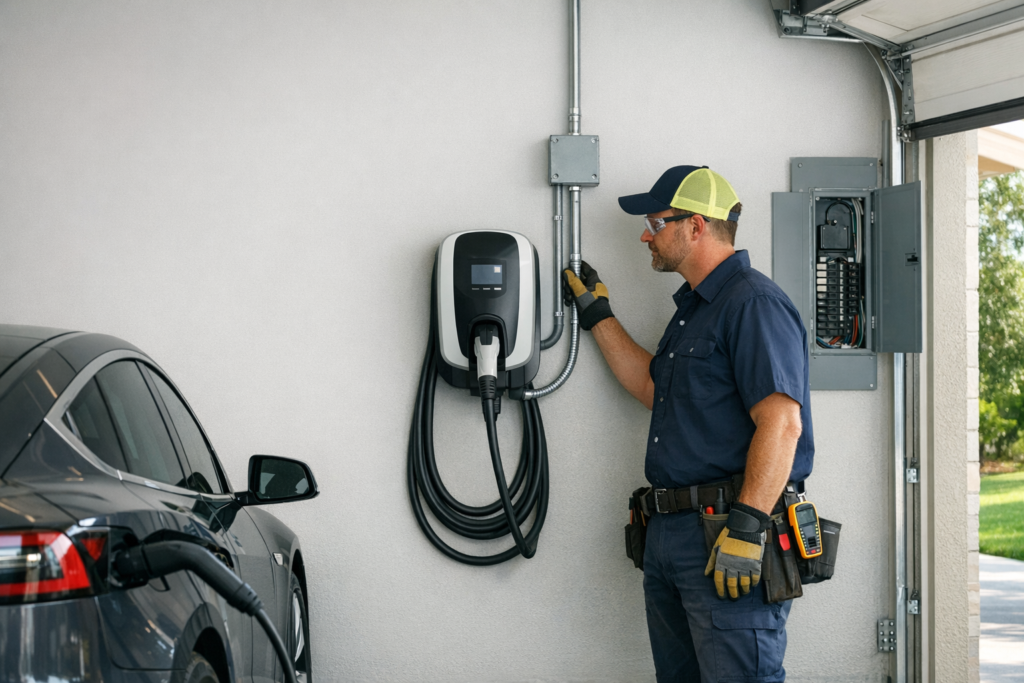
EV charger installation gives homeowners a safer, faster, and more convenient way to charge an electric vehicle at home, but it is not as simple as mounting a charger on the wall. The right installation depends on your vehicle, daily driving habits, electrical panel capacity, wiring condition, charger location, and whether your home can safely support the added electrical load.
For homeowners throughout New Hampshire, Massachusetts, Maine, and Vermont, a properly installed home charging station can make EV ownership much easier, especially during long New England winters when charging performance, garage access, and electrical reliability matter. Before purchasing equipment or scheduling installation, it helps to understand your options and the electrical details that affect safety, performance, and long-term value.
What Is an EV Charger, and How Does Home Charging Work?
The equipment commonly called an EV charger is technically electric vehicle supply equipment, often shortened to EVSE. The actual battery charger is built into the vehicle. The wall-mounted unit or charging cord controls the safe delivery of electricity from your home to the vehicle.
At home, EV charging typically falls into two categories: Level 1 and Level 2 charging. The best choice depends on how far you drive, how quickly you need to recharge, and what your existing electrical system can support.
Level 1 Charging
Level 1 charging uses a standard 120-volt household outlet. It is the slowest charging method and may work for drivers with short daily commutes or plug-in hybrid vehicles. However, relying on an existing outlet can be inconvenient and may not be ideal if the circuit also serves lights, tools, freezers, or other garage loads.
Even with Level 1 charging, the outlet and circuit should be evaluated for condition, grounding, load, and proper protection. Older garage or exterior outlets may not be suitable for continuous vehicle charging without inspection.
Level 2 Charging
Level 2 charging uses a 240-volt circuit and is the most common choice for homeowners who want practical overnight charging. A Level 2 EV charger can restore significantly more driving range in the same amount of time compared with Level 1 charging, making it more suitable for full battery-electric vehicles and households with regular driving demands.
Because Level 2 charging requires a dedicated 240-volt circuit, professional EV charger installation is strongly recommended. The electrician must evaluate the electrical panel, circuit capacity, wiring route, charger specifications, mounting location, and applicable safety requirements before installation.
Why Professional EV Charger Installation Matters
An EV charger is a high-demand electrical load that may operate for hours at a time. That makes the quality of the installation especially important. A properly designed charging circuit helps reduce the risk of overheating, nuisance tripping, damaged equipment, and unsafe wiring conditions.
Professional installation also helps ensure the charger is matched to the electrical system instead of assuming the home can handle any charger at its highest setting. This is especially important in older homes throughout New England, where electrical panels, service sizes, wiring methods, and detached garage circuits can vary widely.
A licensed electrician will typically consider:
- The available capacity in the main electrical panel
- The size and condition of the electrical service
- Existing major loads such as HVAC equipment, electric ranges, dryers, water heaters, and generators
- The charger amperage and manufacturer installation requirements
- The distance from the panel to the charger location
- Whether the charger will be indoors, outdoors, or in a detached structure
- Grounding, bonding, circuit protection, and weather exposure
- Local permitting and inspection requirements where applicable
Can Your Electrical Panel Handle an EV Charger?
Your electrical panel may be able to support an EV charger, but it should not be assumed. The key question is not just whether there is an open breaker space. The more important question is whether the home has enough available electrical capacity for the new load.
An electrical panel can look spacious while still being close to its practical capacity. A licensed electrician performs a load evaluation to determine whether the service can safely support the charger along with the rest of the home. This review is especially important if the property already has electric heat, central air conditioning, a hot tub, a workshop, a large kitchen appliance load, or other high-demand equipment.
When a Panel Upgrade May Be Needed
A panel upgrade or service upgrade may be recommended if the existing system lacks capacity, has outdated equipment, is in poor condition, or cannot safely accommodate the charging circuit. In some cases, replacing an older panel also improves safety, reliability, and future flexibility for additional electrical needs.
Common reasons a home may need electrical upgrades before EV charger installation include:
- An overloaded or undersized electrical service
- No available breaker spaces or limited panel capacity
- Outdated electrical equipment
- Deteriorated wiring or questionable previous work
- A detached garage that lacks adequate feeder capacity
- A planned charger with higher amperage than the home can currently support
Not every EV charger installation requires a panel upgrade. In some homes, the right solution may be a lower-amperage Level 2 charger, load management equipment, or a charger setting that is appropriate for the available electrical capacity. The best approach depends on the specific property.
Choosing the Right Charger for Your Home
The best EV charger is the one that fits your vehicle, electrical system, charging routine, and long-term plans. Bigger is not always better. A charger that exceeds the practical capacity of your electrical system can create unnecessary upgrade costs, while a charger that is too small may not keep up with your driving needs.
Charging Speed and Amperage
Level 2 chargers are available in different amperage ratings. Higher-amperage units can charge faster when the vehicle accepts that power and the electrical system can safely support it. However, many homeowners do not need the maximum available charging rate to wake up with a sufficient charge for daily driving.
An experienced electrician can help you understand whether the charger you are considering is appropriate for your panel and service. In many cases, a moderate Level 2 charging setup provides excellent convenience without requiring unnecessary electrical upgrades.
Hardwired vs. Plug-In Chargers
Some EV chargers are hardwired directly to a dedicated circuit, while others plug into a compatible 240-volt receptacle. A hardwired installation can provide a clean, permanent setup and may be preferred for outdoor locations or higher-output chargers. A plug-in charger may offer more flexibility if you plan to move the charger or occasionally disconnect it.
The right choice depends on the charger model, installation location, electrical requirements, and local code considerations. Receptacles used for vehicle charging must be appropriate for the load, properly installed, and protected as required. This is not an area where shortcuts are worth the risk.
Smart Charging Features
Many modern EV chargers include smart features such as scheduling, energy-use tracking, app controls, Wi-Fi connectivity, and adjustable charging output. These features can be useful for homeowners who want to charge during preferred utility rate periods, monitor consumption, or limit charging during high-demand times.
Smart features are convenient, but electrical safety still comes first. The charger must be installed according to the manufacturer specifications and matched to a properly sized circuit.
Where Should an EV Charger Be Installed?
The best charger location is convenient, safe, and practical for your daily parking habits. Most home EV chargers are installed in garages, carports, driveways, or exterior parking areas. The location affects wiring distance, installation complexity, weather protection, charging cord reach, and cost.
When planning charger placement, consider:
- Where the vehicle parks most often
- The location of the vehicle charging port
- The distance to the electrical panel
- Whether the charging cable will create a tripping hazard
- Exposure to rain, snow, ice, and freezing temperatures
- Wall structure and mounting surface
- Future vehicle purchases or additional EVs
In New Hampshire, Massachusetts, Maine, and Vermont, outdoor installations should be planned with winter conditions in mind. Snowbanks, plowing areas, ice buildup, and freeze-thaw cycles can affect accessibility and equipment exposure. A charger should be mounted where it remains usable during winter without placing the cord where it can be damaged or buried.
What Happens During a Professional EV Charger Installation?
A professional EV charger installation usually begins with an assessment of the home electrical system and the proposed charger location. The electrician reviews the panel, available capacity, wiring path, equipment specifications, and any conditions that may affect the installation.
While every home is different, the process often includes:
- Reviewing the vehicle charging needs and charger model
- Evaluating the electrical panel and service capacity
- Determining the appropriate circuit size and wiring route
- Installing a dedicated circuit for the charging equipment
- Mounting the charger securely in the selected location
- Connecting the equipment according to manufacturer requirements
- Testing operation and verifying safe performance
- Coordinating permitting or inspection steps when required by the local jurisdiction
The installation may be straightforward if the electrical panel is nearby and has adequate capacity. It may be more involved if the panel is far from the garage, the charger is outdoors, the garage is detached, the panel requires upgrades, or the existing wiring needs correction.
Common Mistakes Homeowners Should Avoid
EV charging equipment is becoming more common, but installation mistakes can create real safety and reliability concerns. A charging circuit is not the same as adding a standard outlet for occasional use. It is a continuous, high-demand electrical load that must be designed correctly.
Avoid these common mistakes:
- Assuming an open breaker slot means there is enough capacity. Panel space and electrical capacity are not the same thing.
- Using an existing outlet without inspection. Older outlets, worn connections, or shared circuits may not be suitable for EV charging.
- Choosing the highest-output charger without evaluating the home. The charger should match both the vehicle and the electrical system.
- Relying on extension cords or adapters. These can create overheating and fire hazards and should not be used as a permanent charging solution.
- Ignoring outdoor exposure. Exterior chargers need equipment and installation methods appropriate for weather conditions.
- Overlooking future needs. If you may add a second EV, convert more appliances to electric, or renovate, mention those plans before installation.
How Much Does EV Charger Installation Cost?
The cost of EV charger installation depends on the electrical condition of the home, the charger type, the distance from the panel, wiring complexity, installation location, and whether panel or service upgrades are needed. A simple installation on an adequate nearby panel costs less than a long wiring run to a detached garage or an installation that requires significant electrical upgrades.
Important cost factors include:
- Charger model and amperage
- Dedicated circuit size
- Distance from the electrical panel to the charging location
- Finished walls, ceilings, or exterior conduit requirements
- Garage, driveway, detached garage, or outdoor installation conditions
- Electrical panel condition and available capacity
- Permit and inspection requirements where applicable
The most accurate way to estimate cost is to have a licensed electrician evaluate the property. This helps prevent surprises and ensures the quoted work reflects the actual electrical requirements, not just the charger mounting location.
EV Charger Installation and Older New England Homes
Many homes throughout New Hampshire, Massachusetts, Maine, and Vermont were built before electric vehicles, high-efficiency heat pumps, modern kitchens, home offices, and today’s appliance loads became common. An older home can often support EV charging, but it may need a more careful evaluation.
Older and historic homes may have limited panel capacity, outdated wiring methods, finished basements, detached garages, or previous electrical work that should be corrected before adding a high-demand circuit. In these situations, EV charger installation is also an opportunity to improve safety and understand the overall condition of the home electrical system.
A contractor experienced with New England properties can evaluate practical issues such as foundation penetrations, basement wiring routes, garage locations, winter accessibility, and the balance between preserving finished spaces and installing a safe, code-conscious electrical system.
Should You Install a Charger Before Buying an EV?
Many homeowners benefit from evaluating their electrical system before the vehicle arrives. This is especially true if you are planning a Level 2 charger, have an older electrical panel, park in a detached garage, or want the ability to charge immediately after purchasing the vehicle.
Planning early gives you time to choose the right charger, understand whether upgrades are needed, and avoid rushed decisions. It is also helpful if you are comparing vehicles with different charging capabilities or considering whether your home can support faster charging.
EV Charging, Generators, and Backup Power Considerations
Power outages are a practical concern in New England, especially during winter storms, high winds, ice events, and heavy snow. If your home has a standby generator or you are planning one, discuss EV charging with your electrician before installation.
Not every generator system is designed to support EV charging, and vehicle charging can represent a large electrical load. Your electrician can help determine whether the charger should be excluded from generator-backed circuits, controlled by load management, or integrated in a way that protects the generator and home electrical system.
This planning is particularly important for homeowners who want both reliable backup power and home EV charging without overloading equipment during an outage.
When to Call a Licensed Electrician
You should call a licensed electrician before installing a Level 2 charger, adding a 240-volt receptacle, upgrading your panel, running wiring to a garage, or using an existing outlet for regular EV charging. Electrical vehicle charging is a demanding application, and professional evaluation helps protect your home, vehicle, and electrical equipment.
Contact an electrician if you notice any of the following:
- Breakers tripping when charging or using garage equipment
- Warm outlets, plugs, breakers, or charger connections
- Flickering lights when large appliances start
- An older panel with limited space or unclear labeling
- A detached garage with inadequate power
- Uncertainty about charger amperage or wiring requirements
- Plans to add a second EV or other major electrical loads
Safety warning: Homeowners should not attempt to install a 240-volt EV charging circuit unless they are properly qualified. Incorrect wiring, undersized conductors, loose connections, and improper circuit protection can create serious fire and shock hazards.
Final Thoughts on Home EV Charging
EV charger installation is one of the most valuable upgrades a homeowner can make when transitioning to an electric vehicle. The safest and most reliable installations begin with the electrical system, not the charger box. Panel capacity, circuit design, wiring condition, location, and future electrical needs all play a role in the final result.
Electrical Constructors LLC provides residential and commercial electrical services throughout New Hampshire, Massachusetts, Maine, and Vermont, including EV charger installation, electrical panel upgrades, service upgrades, troubleshooting, inspections, and complete electrical system improvements. For homeowners preparing for electric vehicle ownership, working with an experienced electrical contractor helps ensure the charging system is safe, convenient, and built for long-term performance.